Adobe Analytics, Analytics Strategy, General

Avinash asks me to predict the future

One of my favorite bloggers, Mr. Avinash Kaushik, offered up his web analytics predictions for 2007 in a recent post. At the end of his post he offered this:

In turn I’ll tag our esteemed world leader Mr. Peterson to offer up his top secret list of 2007 web analytics predictions (I am positive it will be super!).

When Avinash calls me “our esteemed world leader” I have to wonder if he’s drinking stronger egg nog than I am at this time of the year, but since Mr. Kaushik is so nice (and positive it will be super!) here goes:

  1. The many smart companies that have invested already in technology and people will increasingly realize that without addressing their Web Analytics Business Process they will still under-appreciate the full value of their investment in web analytics.
  2. Smart people will stop freaking out about how “Web 2.0” is going to be measured and will begin to develop rational and reasonable models for tracking emerging Internet technologies and business models.
  3. Those companies who have deployed sufficiently powerful applications to identify search marketing click-fraud, especially those paying for highly-competitive search terms, may not particularly like what they find.
  4. Emetrics San Francisco will be widely proclaimed the “best ever” thanks to the combination of an interstellar line-up of speakers and a location that (finally!) says “Go out at night and PARTY!” [ Important: I have no knowledge about the speakers at Emetrics San Francisco, I just really trust Jim Sterne! ]
  5. The web analytics analyst community will shake again, although not quite the same way it did when Bob Chatham and I both joined Visual Sciences within a month of each other.

One Bonus:

  1. Avinash, hot off the critical success of his new book, will finally accept his “guru” status in our community and stop being so damn humble all the time. Personally, I want to hear Mr. Kaushik say, “Damn straight, I’m the man!” on stage in San Francisco … Who’s with me?

Damn, it took me waaaaaaaaay longer than six minutes to write five not-so-surprising predictions. I guess I didn’t want to limit my career quite as much as my friend Avinash …

Since we’re still playing games, I’m going to go ahead and tag Mr. Gary Angel at SEMphonic, someone who has always cut straight to the chase, and see if he’ll offer up his own web analytics predictions for 2007. Gary?

Analytics Strategy, General

Tagged …

For Christmas this year, Gary Angel from SEMphonic got me … work! Gary tagged me as part of a blogger’s chain letter that has been going around, kindly noting that he thinks of me as a “kindred spirit” which I take as a great compliment.

Not wanting to be “that guy” who gets a nice compliment and then fails to respond, here are five things you may not know about me:

  1. I have two beautiful children, one girl, one boy, for whom I would do anything. I consider myself incredibly lucky to work for a company that is supportive of my need to work from home and actively participate in my kid’s lives, especially when they’re this young.
  2. I hold a Masters Degree in Botany & Plant Pathology from Oregon State University (GO BEAVS!) My Master’s thesis was titled “Systematics of the genus Otidea in the Pacific Northwest” Don’t know the ascomycete genus Otidea? You’re kidding me. Really!?
  3. For most of my college years I played drums in a “psychedelic bluegrass” band called The Sugar Beets. We played throughout the Northwest, often at large festivals, which contributed to my willingness to present to large audiences. I mean hey, after you’ve dropped a drum stick in front of 5,000 people, talking about web analytics is a piece of cake!
  4. To get around in Portland, I drive one of these, except when the weather is really nice (three days a year in Oregon) when I ride one of these. I owe my small vehicle collection entirely to 1) a very understanding wife and 2) all the nice folks who bought copies of Analytics Demystified in 2004 and 2005. THANKS!
  5. After high school I wasn’t as focused as many of my friends so instead of going straight to college I followed the Grateful Dead around the country on-and-off for two years. You really learn something about yourself when you have to sell organic bagels with cream cheese and sprouts to afford gas to get to the next town … What a long, strange trip that was!

There you have it! Per the rules of the “game”, I now tag five other bloggers that I enjoy:

  1. Xavier Casanova, former co-founder of Fireclick and current CEO at Perenety. Xavier was an inspiration to me as I wrote Analytics Demystified, he shares my taste in cars, and he is one of the brightest guys I know.
  2. Ian Thomas from Microsoft, who I share an interest in cookie deletion and who turned me on to the comics of Jessica Hagy.
  3. A. Clinton Ivy, a co-worker of mine and someone who never hesitates to tell me I’m wrong, regardless of whether I’m wrong or not.
  4. Eric Butler from WebTrends, a former co-worker of mine and a great advocate for both his company’s technology and the web analytics space in general.
  5. Chris Boring, a friend from waaaaaaay back in the day who has always been one of the strongest people I know. Chris is currently fighting Acute Lymphoblastic Leukemia (ALL) and has been blogging about his and his partner Beth’s experience.

Finally, I want to wish everyone who reads my weblog the happiest of holidays. Regardless of what you celebrate or where you are in the world, I sincerely hope that your year ends in a relaxing and enjoyable fashion and you’re charged and ready to go in 2007!

Adobe Analytics, Analytics Strategy, Reporting

How do you calculate engagement? Part II

Given that my last post on measuring engagement generated a fair amount of feedback, I wanted to follow-up with the post that in retrospect I should have published first, the nuts and bolts behind the engagement calculation.

Since there are numerous definitions of “engagement” that could be applied to the online channel, I choose to use the following definition:

Engagement is an estimate of the degree and depth of visitor interaction on the site against a clearly defined set of goals.

My definition sounds like conversion rate except engagement is a more flexible concept, one that can accommodate a variety of business needs such as those described by Bill Gassman in his comments to my last post and those of Craig Danuloff who is looking for a metric that accommodates a variety of visitor activities.

Based on my knowledge of my site visitors and their long-term usage patterns, my engagement goals are as follows:

  1. I would like that visitors would view and interact with certain content on my site;
  2. I would like visitors to subscribe to this weblog to stay connected;
  3. I would like visitors to maintain a low recency with my content, regardless of whether they’re reading blog posts or viewing pages on my site;
  4. When visitors are on my web site, I would like them to spend a reasonable amount of time interacting with my content;
  5. When visitors return to my site, I prefer they remember my domain name and return to my site directly, either via a bookmark or by directly entering my URL into their browser.

Now, many of you will likely argue with these criteria, and fairly so. It’s fine that you may have a different definition of engagement for your site; I think that Bill put it best when he commented:

“Each organization’s version of engagement will be unique. It will be derived from a number of root metrics, probably under a dozen. Common root metrics will be frequency, recency, length of visit, purchases and lifetime value. Some organizations may include visitor actions, such as subscribing, providing personal information, writing a comment, or participating in a blog.”

I’m using the criteria I listed above based on my knowledge of my site visitors, mined from a variety of channels including site activity, email, comments, personal conversations, etc., juxtaposed against my site’s business objectives (see below.) Given a sufficiently flexible analytics package you can build your engagement metric using any goals you like …

Regarding item #1 in the list above, wanting visitors to interact with certain content on my site, here are the activities I am tracking broken down by moderate- and high-value:

Moderate-Value Activities

  • Read my weblog
  • Read about the Web Analytics Business Process
  • Research web analytics jobs
  • Add a link to my link database
  • Read comments about my books
  • Give me an email address
  • Host a Web Analytics Wednesday
  • Join the Web 2.0 Measurement Working Group

High-Value Activities

Because it is very difficult to know a visitor’s intent when they visit a web site, these activities are designed to allow me to examine the visitor not in the context of their intent but rather in the context of my site’s specific objectives. I maintain Analytics Demystified for three primary reasons:

  1. To sell my books
  2. To maintain my visibility in the web analytics field
  3. To have a channel through which I can continue to contribute ideas to our community

You may argue that tracking a visitor’s interaction with specific contents is a poor measure of engagement given that visitors may be looking at an entirely different set of content and are intensely engaged … fair enough. But these lists represent the activities that visitors can perform on my web site that are in-line with my stated business objectives.

If highly-engaged visitors are interacting with some other content on my site, that would prompt me to reconsider that contents contribution to my engagement calculation and perhaps add it to one of the lists above. My belief is that any engagement estimate must take content consumption into account given that it is the content that drives visitor engagement in the first place.

This post is getting long so it’s clear I’ll need a “Part III” (and maybe a “Part IV”) but here is something tangible to chew on until I have time to post again. Based on my five business goals stated above, my engagement calculation is essentially this:

(Pct High-Value Content Consumption Sessions + Pct Moderate-Value Content Consumption Sessions + Blog Subscriber Reads per Session + Pct Recent Sessions + Pct “Long” Sessions + Pct Direct Sessions) / 6

I am calculating the percentage of sessions on a per-visitor basis and summing those percentages to generate an “engagement score” between 0.0 and 6.0. I convert this score to a percentage itself to make it easier to read and voila! I can apply my engagement metric to any dimension I am tracking in Visual Site.

By clearly defining my engagement goals and then systematically scoring visitors against that framework, I can build a metric that can be objectively applied regardless of whether visitors buy a book. I can apply my engagement estimate to any dimension I am tracking on my site, allowing me to discover patterns of visitor behavior that would not be obvious based on more traditional metrics such as conversion rate, session duration, or page view count.

Just so I don’t lose you, here is one of the visualizations I am using to better understand visitor engagement showing visitor engagement by percent of visitors by visitor city:

It’s hard to see with the scale I’m providing in this image but I can assure you that the long-tail is there. And sure, with my $50 book I’m unlikely to launch a geo-targeted marketing campaign in markets where visitors are, on average, twice as engaged as my site-wide population … but maybe you would!

Until next time, I welcome your comments and criticism.

Adobe Analytics, Analytics Strategy

Frank Faubert writes in …

Frank Faubert, who I referenced in my last post, wrote in and had this to say:

“I think you have a flaws in both your data collection, and in the way you are thinking about engagement. I have been subscribed to your RSS feed for quite a long time, and I read it (along with many others) on a daily basis. I also have been to your web site in the past 90 days, though admittedly I don’t visit very often — mostly just to look at the status of the current Web Analytics Wednesday events.

If asked, I would consider myself an engaged visitor of your site, as I consume all of the content that you are generating, on a daily basis. Given that you push the entirety of your post in your RSS feed, I have no need to visit your site directly. (And in fact, if you were to change this to only publish snippets of your posts via RSS to force me onto the site, I would unsubscribe.) Does the fact that I am very busy, yet I can leverage the technology of a good RSS aggregator to consume your content anyway, really make me any less engaged?”

Frank makes a few really good points so I wanted to clarify something. I chose Frank as an example in my last post since I know him to be a really good guy and someone who was likely to provide thoughtful feedback. Frank didn’t let me down.

In fact, at the present time, I can’t actually track Frank’s engagement score and tie it directly to him personally (via his email address). Here is a view of Frank’s activity on my web site over time:

As you can see, Frank must have deleted the cookie that tied his email address to his site activity back in late 2005. Fair enough, Frank–I sometimes delete cookies too!

But Frank raises valid points about whether his engagement with my RSS feeds should be counted as “engaged”, and he’s absolutely correct! I’m pretty sure that Frank is located in Waltham, MA based on his attendance at the Web Analytics Wednesday event that Akin Arikan (also of Unica) hosted there awhile back. Here is a quick snapshot of activity to my site and RSS feeds from Waltham over the last eight weeks:

Clearly a few folks in Waltham are visiting the site and reading the blog, and the average engagement for visitors from Waltham is about 18 percent higher than average.

But Frank raises another really excellent point, albeit indirectly, should visitors who are actively interacting with RSS or XML-based content get a “push” in their engagement score? I mean, based on his response, Frank is doing two of the six things I have identified as “most important” on my site from a content and activity perspective (more on that in my next post), so if I could uniquely identify Frank I could vet whether his score is correct based on his description of his interaction with my site.

In reality I only provided Bill and Frank as examples to show how ultimately engagement needs to take real people’s activities into consideration, at least as the metrics are being defined and worked out. The engagement metric is really designed to be applied to dimensions other than people given that at the individual level, well, cookie deletion happens and thusly problems like the one that Frank highlights occur. Now, I suppose if you could positively identify individuals every time based on a login or customer ID that would change.

I hope I didn’t offend Bill, Frank, Robbin, or any of the other folks listed in that table as having visited my site from time-to-time. If I did, please accept my most humble of apologies. I don’t usually do this type of analysis but it helped to prove a point.

Anyway, thanks for writing in Frank and I’m glad to see you’re still reading! Hopefully we’ll get to connect next time I’m in Waltham and please give my regards to Akin, Ed, and everyone on the Unica analytics product team.

Adobe Analytics, Analytics Strategy, Reporting

How do you calculate engagement? Part I

My good friend Clint Ivy and I were talking awhile back and he asked me, “So what do you think about Scoble’s call for an engagement metric?” I said, “Huh?” since I had long since stopped reading Robert Scoble, but apparently he had rubbed Clint the wrong way.

Anyway, I had been working on a project for a customer and we had been talking about how to measure engagement on their web site. We’d gone round-and-round on ideas about what constitutes an “engaged” visitor and narrowed it down to a few key areas:

  1. The visitor views “critical” content on the web site
  2. The visitor has returned to the web site recently
  3. The visitor returns directly to the web site some of the time
  4. Some high percentage of the visitor’s sessions are “long” sessions
  5. If available, the visitor is subscribed to at least one available site feed

So, with this in mind, visitors that are consuming content slowly and methodically and returning directly to the site are well-engaged. Visitors who have also subscribed to some type of “push” feed are more engaged, and even more so if they’ve returned to the site recently.

Sounds reasonable, doesn’t it?

Using this model, sites like Yahoo! and Digg will have very engaged visitors, whereas sites like mine will have slightly less engaged visitors. That also sounds reasonable, given that Yahoo! and Digg are social networks and Analytics Demystified is more or less a weblog, a geek hub, and a job board (in that order).

It turns out that my audience is, on the whole, 32.3 percent engaged.

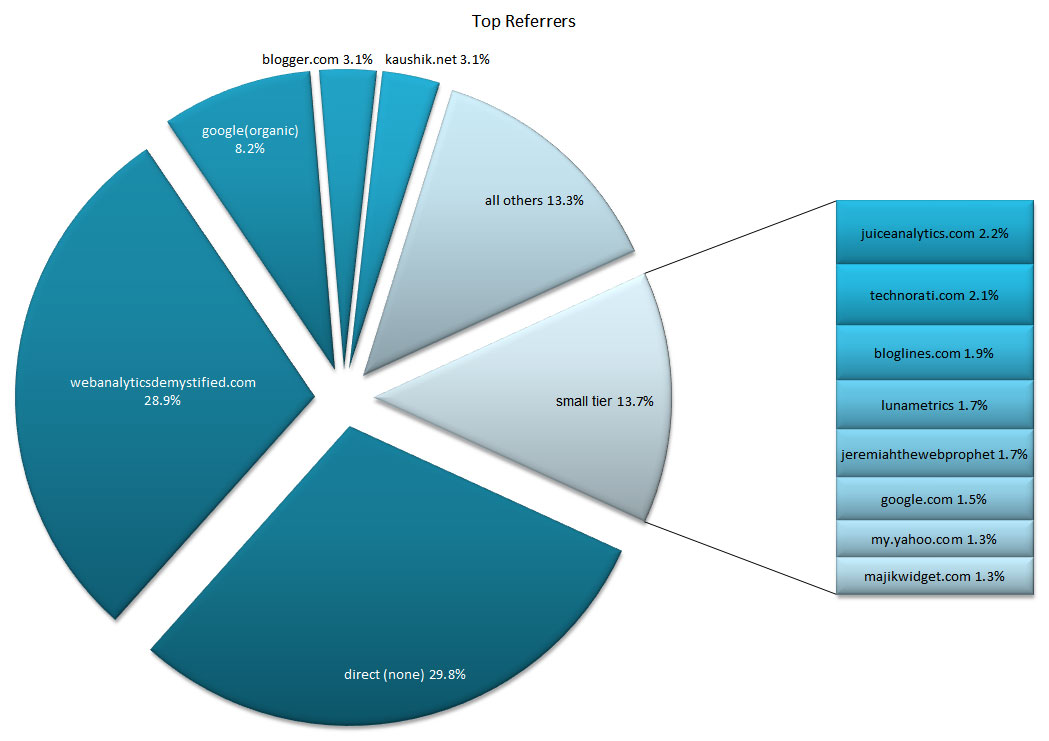
Perhaps more importantly, visitors that I get from the following sources are engaged at the following rates:

You can see there that my friend Avinash is sending me pretty good folks but Avinash’s people are slightly less engaged with my site than the “average” visitor. That and they hopefully already have my books because pretty much none of them are buying Analytics Demystified or The Big Book of Key Performance Indicators from my site! They’re not even taking advantage of the great combo-offer I have on both books!

Perhaps most interesting and wonderful is that my engagement metric allows me to build wonderful visualizations like this scatter-plot to compare the volume of referred visitors to engagement in a way that more easy on the eyes than your basic table or line graph.

Most importantly, because I am running the industry’s most easy-to-use yet powerful web analytics application supporting multi-source and multi-channel data analysis, I can vet my engagement index against real people who have come or are coming to my web site!

Cool, huh?

So Bill Gassman from the Gartner Group is among the most engaged visitors I have (I am quite honored, Bill!) Bill is consuming the content I deem most important to creating a relationship with my visitors, he is subscribed to my weblog, he keeps coming back, his sessions are of reasonable length, and he comes directly to my site or feed over 2/3rds of the time.

Bill is nearly 54 percent engaged with my site, approaching twice the average!

Compare Bill to Frank Faubert from Sane Solutions. Frank is seeing all of the content I believe to be most important and he also is well retained. However, Frank is not subscribed to my RSS feed so most of the time he is getting to my content indirectly then only spending a short period of time reading that content. Moreover, Frank hasn’t been to my site in the last 90 days.

Frank is only 21 percent engaged with my site so I guess maybe he doesn’t like me now that I’m not an objective, third-party anymore.

I’m interested in your thoughts about my engagement metric. Do you think I’m using the right inputs? Or am I missing something critical to how this metric should be calculated? I’d love you input since I know that the folks reading my weblog are among the brightest in the web analytics industry …

Next Time: Being a big fan of “showing my work”, I’ll provide the calculations behind my engagement metric so that you can calculate your site’s engagement in the safety of your own home. My hope is that through your comments and criticism I’ll be able to refine this metric down to something that any vendor can implement and any practitioner can use.

General

So you want to be a web analyst?

As I’m finally starting to catch up on things around here I noticed that Jason had recently published a Clickz article titled Becoming an Experienced, Invaluable Web Analyst in which proposes a few strategies for folks who want to get into web analytics. One of the things he proposes is to get a job working in an analytics position at an interactive agency, something I had been thinking about while reading the first job posted on my new job board.

This posting, advertising for a VP/Associate Director of Digital Media Analytics and Technology, sounds like a dream job for any fairly senior consultant with a heavy background in web analytics. Some of the qualifications the interactive agency is looking for include:

  • Familiarity of view-through conversion technology and cookie-based tracking, rich media vendors as well as ad serving platforms and paid search engine marketing data sources
  • Deep functional expertise in database marketing, integrated channel marketing (including online based channels such as websites, banners, email and search), analytical tools, techniques, and other infrastructure requirements
  • In-depth experience in website analysis and knowledge of infrastructure requirements to deliver measurement solutions
  • Strong understanding of blue chip internet business models and online processes, terminology, concepts and strategies

Clearly this isn’t the entry level position that Burby is talking about … but this person is going to join a Strategy and Analysis team of 150 people and have a substantial impact on his or her customers online business. And this person is going to need entry-level folks, folks who don’t have the same experiences necessary to fill this position, but people who:

  • Are technology-savvy, but business-minded;
  • Are good at writing, but great at presenting;
  • Are enthusiastic about data, but recognize that not everyone else is;
  • Are patient, but unwavering in their desire to improve the current situation;
  • Are willing to pay their dues, but unwilling to generate great analysis that is ignored;
  • Recognize that reports are a necessary evil, but know the real value is in the analysis

(Oh, and it doesn’t hurt to have read one or all of my books!)

There are tons of people like this out there–trust me, I am in communication with folks like this all the time, it’s just a matter of companies understanding how to recognize them when they apply for open positions given that they don’t have “8+ years experience professional statistical analysis and modeling experience, e.g., advanced web analytics, advanced survey design and
analysis, econometrics, psychonometrics, data mining, or clinical trial analysis/biostatistics” plus a PhD (preferred) on their resume but be willing to report to the Director of Analytics.

Holy crap, huh? It’ll be easier to find a headless chicken who still walks than it will to fill that position!

If you’re interested in working in web analytics and wondering how to get started, I’d love to hear from you. And if you have tried to break into the field to no avail, I’d also love to hear from you. Between my new job board and dozens of friends companies who are constantly looking for the kind of people I describe above, I might just be able to give you a hand.

General

Are you trying to hire experienced web data analysts?

If you are, you should consider advertising on my new job board. I’ve outlined a few reasons that you might want to advertise at the old job board but suffice to say, I’ve been somewhat overwhelmed lately by the number of companies that have asked me to help them find qualified web analytics workers.

Given the evangelism I’ve done in the past three years to encourage companies to actually staff for analytics, hopefully this new advertising opportunity will connect people and companies in a more efficient manner. Based on the email I get, and the usage patterns I see on this site, I think that my site’s audience would be described as “well qualified” for most of the positions likely to be advertised (who knows, maybe one of you will be a “Chief Analytics Officer” someday!)

Anyway, let me know what you think about the new board. If you have any questions about advertising, you can email me directly.

Analytics Strategy, General

On promises and porn stars …

Like many folks here in the United States I have been away from “civilization” for the past handful of days enjoying the Thanksgiving holiday. My wife and kids and I have had a fantastic time in Sunriver, Oregon, playing in the snow, relaxing at the spa, and cheering as Santa Claus rolled into town (my oldest is three so work with me here …)

I told my wife I wouldn’t go online on vacation. I lied.

I’m glad I did go online this weekend since two very well written blog postings were published that speak to my decision nearly a year ago to leave JupiterResearch and come to work at Visual Sciences.

You can begin to understand my decision (at least philosophically) by reading posts written by Aurelie Pols of OX2 in Belgium and Gary Angel of SEMphonic in San Francisco. Aurelie’s post about Visual Site is pretty long so I recommend you read it and the comments yourself, but Gary summarizes my thinking in a way that forced me to laugh out loud. Regarding my position at Visual Sciences, Gary says (and I quote, because I wouldn’t make something like this up myself):

[Eric is] an evangelist (and a good one) for a tool so sexy it’s the analyst’s equivalent of dating a porn star!

Gary, my man, you have a way with words. My wife, however, who was reading your blog post over my shoulder, wants to have a few words with you 😉

Anyway, thanks to Aurelie, Rene, and Gary for taking the time to sit down with me and look more closely at Visual Site. Your comments about the technology and company are greatly appreciated.

Adobe Analytics, Conferences/Community

Do you live in the Washington, D.C. area?

If you live in the Washington, D.C. area, here are two events you should know about:

Speaking of Phil Kemelor, if you haven’t already checked out his book (see link above) you should have a look and see if it’s for you. Full of charts, diagrams, and checklists, this book is a real “hands on” guide to web analytics.

Analytics Strategy

The FTC is being asked to investigate the regulation of data collection via the Internet

I was sifting through my email and I noticed that the Center for Digital Democracy and the US Public Interest Research Group are petitioning the US Federal Trade Commission to stop Microsoft from developing technology for its AdCenter online advertising platform. While the petition largely focuses on Microsoft, a wide variety of technologies are being targeted.

From the petition (PDF, available here, emphasis mine):

The Center for Digital Democracy and the U.S. Public Interest Research Group, two of the leading public-interest advocacy groups working on behalf of a more diverse, open, and competitive online environment, call on the FTC to undertake an immediate, formal investigation of online advertising practices, focusing on five areas of concern:

  • User Tracking/Web Analytics
  • Behavioral Targeting
  • Audience Segmentation
  • Data Gathering/Mining
  • Industry Consolidation

Collectively, these five areas represent the foundations of an entirely new online environment, one in which engagement gives way to entrapment, in which personalization impinges on privacy. It is an online environment, in short, that threatens to turn the traditional media equation on its head–a media that consumes us.

At fifty pages this document requires a pretty deep read to understand exactly what risks this petition creates for the web analytics industry. Several analytics vendors are specifically cited including Clicktracks, Deepmetrics, Unica and Coremetrics, but none appears to bear the brunt of these groups fearmongering more so than Omniture.

From the petition:

The key to Omniture’s data mining lies in its collection of so-called “xographic” data, a scientific-sounding neologism that masks the serious breach of privacy that results when online and offline data are combined. The Omniture blog provides ample evidence of such practices …

The petition then goes on to cite from recent blog posts made by Omniture’s Matt Belkin which describes SiteCatalyst’s ability to incorporate personal information into the Omniture Datawarehouse based on a unique customer ID. To be fair, Omniture is far from alone in their ability to integrate this type of information, nor in their marketing efforts to evangelize multi-channel data integration.

The document then cites a passage from Omniture’s 10-Q filing that describes how governmental regulation could negatively impact the companies ability to collect information, following up with this statement:

Omniture’s corporate self-interest notwithstanding, the kind of privacy environment it fears–one in which consumers must give their permission before surrendering personal data online–is one that FTC policy should mandate.

The document presents the following conclusions (emphasis mine):

The U.S. digital media system is at a crossroads. Over the next few years, as the distinctions between online and “old” media blur still further, there will be a ubiquitous interactive environment. So, too, in this fluid, new environment, with all manner of data compiled and analyzed, will the distinction between anonymous and personally identifiable information disappear. For these reasons it is critical that the FTC act now to protect the interests of the public. The FTC must require notice of all information collected, and full disclosure of how that data will be used. The commission should ask Congress to pass federal legislation requiring affirmative consent for all data used–which must be regularly updated and re-approved by users. An all-embracing opt-in should be the minimum standard. All data collection and e-commerce marketing techniques must be unbundled, disclosed, and given affirmative consent by users. Indeed, the commission should also strive to have industry develop meaningful codes of conduct related to marketing that go beyond these basic principles.

The document’s authors are apparently proposing that web sites explicitly ask visitors for permission to track their activities. The implied alternative is that sites cease using web analytics and behavioral targeting tools.

Obviously this is a really big deal, essentially the moment many of us have been waiting for (and hoping would not arrive.) The regulation proposed in this petition, if adopted, would make all of us long for the good old days where cookie blocking and deletion was the extent of our problems. This regulation is the “scary moment” that Bob Page of Yahoo! hypothesized at Emetrics in Santa Barbara in April of this year.

The Web Analytics Association needs to get involved in this issue right away.

This is not the kind of petition that can be dropped on the world and not addressed by the closest thing the web analytics industry has to a lobby or public voice. Given the companies present in the corporate membership, companies that include Google, Yahoo! and Deepmetrics (the web analytics technology specifically cited in the Microsoft portion of the petition), in my humble opinion, the WAA needs to draft a public response to the assertions and allegations made in this petition.

As has been suggested before, ironically most recently on October 6th in a thread in the Yahoo! group titled “Web Analytics and Data Privacy” started by Jim Newsome of GA-Experts, the WAA needs to move quickly to establish some type of meaningful code of conduct for data collection and data storage. Given that this is something that Bob brought up months ago and that consistently stays on the radar screen (see Avinash’s challenge #5), this is an issue that absolutely needs to be addressed as a community, not as a handful of companies that at times is incapable of seeing beyond the next RFP response.

I welcome your comments and am willing to lend whatever hand and/or voice I can to protect our industry and every companies investment in web analytics technology.

Reporting

More thoughts on using visits or visitors to calculate conversion rates

Recently I was talking to a friend who was asking about my post on buyer versus order conversion rates I posted recently. We had been talking about the “every session is an opportunity to convert” mantra that some folks push as gospel; his comment to me was funny. He basically said, “I manage analytics for a company that does over $100 million annually through our online channel and that type of thinking is [crap].”

I told him to tell me how he really felt.

After he read my post he said he’d started calculating the delta between buyer and order conversion rates for his own site on both a daily and monthly basis; he’d been calculating both buyer and order conversion rates as part of his daily KPI set but hadn’t really thought about the difference between them. While he wasn’t surprised to see an average of six to eight percent difference on a daily basis, he was surprised to see that on a monthly basis his order (visit-based) conversion rate was, on average, twenty-seven percent lower than his buyer (visitor-based) conversion rate!

Put another way, by subscribing to the “only use visits to calculate conversion” methodology my friend would be under-reporting the likelihood that he would sell products to real people on a monthly basis by nearly one-third!

So he got me thinking, I wonder what the monthly delta is between buyer and order conversion rates (BOCR Delta) is for book sales on my web site. Have a look:

Aside from the fact that conversion is off slightly over the past few months, likely owing to the fact that I’ve stepped up my efforts to bring traffic to the web site, you can see that I have much the same problem as my friend on a monthly basis. Were I to rely on visit-based conversion rates alone, my understanding of how real people purchase on my web site would be incomplete.

Anyway, I stand by my original statement, you need both visit- and visitor-based conversion rates to understand how your audience converts. Both metrics tell you something valuable; one tells you about the person doing the converting, the other tells you about the process.

I welcome your comments on this subject. Perhaps you disagree with me? Or perhaps you agree but are having a hard time calculating one or the other rates using your web analytics application?

Analytics Strategy

My presentation on The Web Analytics Business Process is on slideshare

Thanks to some anonymous poster to my weblog, you can now view my Emetrics presentation on the Web Analytics Business Process over on slideshare or use the following embedded object (how cool!)

[I had to remove the object since it was breaking my site … sorry!]

I’m nearly done with the annotated version but it’s been slow going because work has been really busy lately. Keep watching this weblog!

Analytics Strategy

Gaining momentum for a Web 2.0 Measurement Working Group

Yes, I have not completely forgotten and last night I made some progress! You can now sign-up to join the Web 2.0 Measurement Working Group on my web site. Once enough folks indicate/reiterate their intent to participate I’ll schedule a Skypecast and we’ll get the party started.

In the meantime, I wanted to start a list of “suggested readings” on the subject and would love your comments on what should be included. I have a handful of items bookmarked — blog posts, articles, reports of the “death of the web page”, and the such — but I’d love your collective feedback on what has already been written that feels important to the subject. Comment me your URLs and I’ll add them to the Web 2.0 Measurement Working Group sign-up page.

Analytics Strategy

June Li from ClickInsight has a great suggestion about implementing process

June Li was having trouble downloading my presentation on the Web Analytics Business Process in Firefox. Has anyone else noticed that? I’ll try and get the file in a zipped format in the next few days to save folks time downloading.

June had a great suggestion for companies just getting started with explicitly considering how web analytics creates value inside their organizations. She commented that instead of going directly to digital flowcharting that she’s had success with “yellow stickies”. Posted on a wall or roll of paper, the stickies promote rapid planning and iteration while the organization carefully maps decision points, events, tasks and sub-tasks. Then, when stakeholders are comfortable with the process and integration points for web analytics, the stickies can be transferred into digital format for widespread discussion and distribution.

An excellent suggestion. Thanks June!

General

The strangest thing that has happened to me in a long time …

At Emetrics I unfortunately had to miss Jim Sterne’s keynote speech. When I got to the conference people had these little cameras and they kept walking up behind me and taking pictures. Well, this made me feel a little self-conscious so I asked … apparently Jim Sterne had told people to take pictures of my pony-tail.

I suspect this was in reference to all that Fred McMurry baloney from earlier this year when a Visual Sciences competitor posted under a lame pseudonym spreading obvious lies about my person and offering $325 to anyone who would cut off my hair … while I liked the biblical allusion to Sampson I’m always wary when someone threatens me with physical harm.

Call me crazy.

Regardless, there are some funny pictures of the back of my head showing up on the Internet. Since I’m pretty close to taking “Fred” up on his offer for the money and cutting my hair do donate to Locks of Love, I suppose these shots will help me tell the inevitable “back when I had hair” stories that my kids will have to hear as I age.

If you are reading this and took some pictures at Emetrics (not just of my hair), push them to Flickr and tell me where they are in the comments to this post and I’ll blog about them later.

Analytics Strategy

The Web Analytics Business Process

I gave my presentation at Emetrics yesterday, outlining my thoughts about what I call the “Web Analytics Business Process” to a packed room. The response I got was tremendous and I spent the rest of the day talking with very bright people from a diverse assemblage of companies about how the Web Analytics Business Process manifests, how they can begin to diagram their own Web Analytics Business Processes and even discussing how the process has already driven success in companies that have something very similar.

I was asked by several people to make the presentation publicly available and hope to do so next week. If you’re interested in getting a copy, watch this weblog.

A few good questions emerged from the Q&A sessions and are worth addressing in a forum that allows comments to spur conversation.

  1. Megan Burns from Forrester Research, who has a great deal of experience implementing CMM in software development, wisely commented that she had seen software companies generate reams of process diagrams that ultimately became “shelfware” and failed to provide the level of guidance and aherence to process desired. She asked me how companies could avoid that problem when deploying the Web Analytics Business Process.
  2. One of my competitors, and I got this secondhand from a blogger, insisted that “process was wasteful in web analytics” and that all companies needed were “a few quick wins, made by clearing off the low-hanging fruit” and that these wins would drive the entire organization to tightly adopt web analytics.

Megan’s experience in this regard certainly surpasses my own, at least in terms of CMM and business process in the software development model. I don’t disagree that there is some risk associated with documenting business processes, risk that the excercise is only that, an excercise, and that the results are quickly set aside to respond to the next fire drill. But in my experience, the adoption of the Web Analytics Business Process will push companies in the right direction and encourage them to think about web analytics as something you do on an ongoing basis, not something you do once and awhile.

I conceeded that yeah, someday people might have reams of Web Analytics Business Process diagrams sitting on a shelf somewhere, perhaps next to an old copy of WebTrends Log Analyzer, collecting dust. But I firmly believe that the process of getting to a point where the dust can be collected is extremely valuable.

Regarding the wisdom of eschewing process and instead looking for “quick hits” and “early wins” based on identifying low-hanging fruit I can only offer this: The Web Analytics Business Process is designed to provide a framework for turning short-term insights such as these into long-term, repeatable results. As such, there is no inconsistency in the two approaches but I strongly believe any vendor/consultant telling your organization that you can do web analytics without considering the process of “doing” web analytics simply doesn’t get it.

Why do I think this? Simply because we’ve already been through all of this. THERE ARE NO SILVER BULLETS! Web analytics is work, work that people and organizations need to approach in a systematic way. If you still believe, now, in 2006, that deploying any web analytics solution, regardless of price, will somehow dramatically change your online business without consideration of how the solution will be integrated into your existing business processes, you’re simply not paying attention to how we’ve arrived at where we are as an industry today.

Yes, there is a lot of low-hanging fruit that needs to be cleared. Yes, that low-hanging fruit being cleared, in many instances, will drive organizational excitement about web analytics. But yes, I do firmly believe based on my personal experience in the web analytics marketplace, that in order for this excitement to be sustained, companies need to think strategically about web analytics.

I welcome and encourage your comments on this subject and as I mention earlier, I hope to have an annotated copy of my presentation available for download sometime in the next few weeks.

Analytics Strategy

Interested in learning more about Visual Sciences at Emetrics?

If so, there are a couple ways you can go about it.

  1. Go see our co-founder and CEO, Jim MacIntyre, talk about correlating multi-channel data across the Enterprise from 10:00 to 10:30 AM on Wednesday, October 18th.
  2. Look for Visual Sciences staff at the event and introduce yourself. We have a private suite set up to give demonstrations near the event hall.
  3. Come see my presentation on “The Web Analytics Business Process” from 2:30 to 3:20 on Monday, October 16th and then introduce yourself afterwards.
  4. Email me directly and we can arrange a time to meet at the event.
Analytics Strategy

More information on the Web 2.0 Measurement Working Group idea I had …

Clint’s right, I need to get the Web 2.0 Measurement Working Group organized. Curse Clint for being right, again. I’d offer excuses, but they’re all lame like “busy doing my real job” and “spending time with my children” … Suffice to say, I hope to corner folks at Emetrics next week and get the ball rolling. If you’re going to be there, look for me and hopefully we can share ideas about what a measurable “Web 2.0” will look like.

For those of you not attending Emetrics, give me another week after the event and I’ll create the Skypecast.

Conferences/Community

Web Analytics Wednesday Portland …

I have to say that last night’s Web Analytics Wednesday event in Portland, Oregon was a smashing success! We had good representation from a number of companies including WebTrends, Powells Books, Intel, Mentor Graphics, ISITE Design, the Web Analytics Association and of course, Visual Sciences who picked up the tab for the evening. I was smart enough to bring my camera so here are a few photos I grabbed while we socialized.

First we have Gordon, currently of Intel, and Jaimie, formerly of Intel, currently of Powells Books. Both gentlemen are sporting “Don’t Be a Fred” solidarity pins and have copies of Analytics Demystified and tasty Oregon homebrew so you know these guys are all set.

Next up is WebTrends own blogger, Eric Butler, seen here sporting his “Don’t Be a Fred” pin and flashing a smile that only a blogger who knows his picture is going to end up on a blog can flash. I’ve known Eric for years since we were both early-days hires at WebTrends. Eric has been solid as a rock, advancing through the ranks at WebTrends to his current position of Director, Systems Architecture.

Eric’s great to talk to because he has a ton of perspective on how measurement really happens. While he and I are always very careful about what we discuss (we being competitors now and all that) I very much look forward to his attendence at WAW events.

My third picture shows Nancy Taffera-Santos, formerly of WebTrends and currently in sales at DIRECT Magazine and the co-chair of the Web Analytics Association’s events committee. Nancy has a ton of energy and is tres enthusiastic about web analytics in general.

Nancy told me that she’s looking for a new co-chair for the WAA Events Committee–if any of you reading this are interested please let me know and I’ll get the word to Nancy. As you can see by the WAA informational page she’s holding up, Nancy is working hard to expand the ranks of the association and providing high-quality events and content for all web analytics practioners.

Finally, we have a picture of Jeff Katz, former WebTrends and current contractor with a variety of well-known organizations, sleeping. Jeff, like myself, has two small children at home and works entirely too much so I didn’t fault him for catching a nap at WAW.

As you look down the table you can see folks from Intel, Mentor Graphics and, at the end of the table, WebTrends new Digital Product Marketing Manager, Jenna Bussell. Jenna just moved to the Rose City from New York so I give her three more weeks before she’s bored to tears with our “country lifestyle” we appreciate so much here in Portland. I am told that inside WebTrends global HQ she is referred to as “Hurricane Jenna” … and it’s only her second week on the job.

All in all we had an excellent turnout and a gret time. You can read about other Web Analytics Wednesday events around the country in the Yahoo! group:

General

I've added a web analytics calendar to my web site

Some folks have noticed but thanks to Google Calendar I’ve added a Web 2.0 web analytics events calendar to my web site. I’m still looking around for the API to see if I can instrument it for measurement the same way I did the Web Analytics Wednesday Google Map. Even if there is no API that provides me good hooks into the application (it’s called via an IFRAME) I have a few ideas.

Anyway, if you have a web analytics event that you’d like added to this calendar please let me know. All I need is the event name, the date, the time, a description and a URL or email address to point people to. I’m pretty sure I can generate a RSS feed from the calendar so a new feed of web analytics events cannot be far behind.

General

Okay, so maybe I haven't been to every Emetrics ever …

E-consultancy published a nice interview with me today covering my thoughts on measuring Web 2.0. One of the questions they asked was about whether I think companies are getting better at using web analytics. In my answer I shamelessly promoted Jim Sterne’s Emetrics Summit stating that “I’ve been to every Emetrics Summit ever held …”

And then I got an email from Brian Clifton, PhD., Googler and co-moderator of the Yahoo! group reminding me that he’s never seen me at Emetrics London or Emetrics Munich.

Touche!

As Dr. Clifton correctly states, what I should have said was “I have been to every Emetrics Summit ever held IN THE UNITED STATES …” which is true. I just happened to be living a short drive away from Santa Barbara when Jim started his event. The rest, as they say, is history.

Kudos to Brian for keeping me honest.

Reporting

On visits and visitors …

I have a Google News alert on the phrase “web analytics” that had the most interesting summary I’ve seen in a long time:

The Web Numbers Game
Multichannel Merchant – Stamford,CT,USA
Adds John Squire, vice president of product strategy for San Mateo, CA-based Web analytics firm Coremetrics: “We think [Belkin’s argument] is fundamentally flawed …

The entire article is at Multichannel Merchant magazine online. The basic argument is that some people think it’s better to use “visits” to measure conversion than “visitors”, ostensibly because every visit is an opportunity to convert.

Uh, what?

While I’m inclined to agree with Jason Palmer from WebTrends and John Squire from Coremetrics on this issue for no other reason than I know both guys moderately well and very much respect their opinions, the debate about whether online retailers should use “visits” or “visitors” in their conversion rate calculations is moot.

Use BOTH Visit- AND Visitor-Based Conversion Rate Calculations

Every online retailer should be using two very basic and very much standard calculations:

  • Order Conversion Rate (OCR) defined as the number of orders taken divided by the total number of visits to the web site during the same period.
  • Buyer Conversion Rate (BCR) defined as the number of customers converted divided by the total number of visitors to the web site during the same period.

Setting aside for now any issues associated with the definition of “visitor”, examining these two conversion rates side-by-side gives you unique perspective into your customer base. Do you sell low-consideration items? Likely your OCR and BCR will be similar. Do you sell high-consideration items? Likely your OCR will be low but your BCR higher, especially if you’re looking across weeks or months.

The example given in the article, one where one visitor visits four times and purchases twice, yielding a OCR of 50% and a BCR of 200%, is strangely presented as if the BCR is “bad information.” The original author states (lifted from the article):

“If you use weekly unique visitors, my conversion rate is 200%. If you use visits, my conversion rate is 50%. Which is a better representation of site effectiveness? Clearly, the 50% [number] is much more valuable in understanding where your site may or may not be performing optimally.”

Really?

I don’t understand why any good retailer doesn’t want to know that some percentage of their audience is making more than one purchase during the period under examination? Is order conversion rate a better indicator of site effectiveness? Probably, but it’s a poor indicator of customer loyalty. Is buyer conversion rate a better indicator of customer loyalty? Perhaps, but it’s a less-good indicator of whether your site suffers from process abandonment issues.

Personally as an online retailer, I want both rates.

I need my buyer conversion rate because, much like Intuit who sells TurboTax, I sell “moderate consideration” items but I don’t expect to sell more than one or two items to any given customer. The “every visit is an opportunity to convert” mindset doesn’t help me understand which of my marketing efforts are effective in the long run.

But I need my order conversion rate because I believe in controlled experimentation and want to maximize the likelihood than when a visitor does decide to cart one of my books that they’ll complete the purchase. Here if I focus exclusively on my buyer conversion rate but look at short periods of time then I’ll be sad since it often takes folks more than one visit to make the purchase.

Applying Order and Buyer Conversion Rates to Referring Sources

All of the above is profoundly more interesting when considered in the context of referring sources (domains, campaigns, feeds, etc.) Here I watch my order and buyer conversion rates closely to better understand which referring sources are sending me highly qualified traffic. Consider two examples:

  1. Google Japan (www.google.co.jp) referred visitors to my site have a buyer conversion rate of 4.5% and an order conversion rate of 3.4% (a difference of 24 percent)
  2. Hurol Inan (www.hurolinan.com) referred visitors to my site have a buyer conversion rate of 1.0% and an order conversion rate of 0.9% (a difference of under 5 percent)
  3. Avinash Kaushik (www.kaushik.net) referred visitors to my site have an order and buyer conversion rate of 0.0%

What does this tell me?

  • Visitors from Google Japan visit more often before making their purchase, but when they make up their mind a higher percentage are likely to complete the transaction.
  • Visitors from Hurol Inan are less likely to make the purchase, but those that purchase don’t take multiple sessions to complete the transaction.
  • Avinash doesn’t link to my site or talk about my books very often

See how that works?

Want a Really Interesting Metric?

One thing I calculate to help me better understand my order and buyer conversion rates is the percentage-wise difference between the two. Basically:

(BCR – OCR)/BCR = Percent Difference between Buyer & Order Conversion Rates

This way I can rank-order by referring sources and campaigns to look for sources that are likely to convert more like Google Japan and more like Hurol Inan in the example above. In my dataset, this calculation ranges from 60% at http://www.fortune-cookie.com (don’t ask) down to -1.3% for visitors referred from http://www.comcast.net. The negative number tells me that visitors are making repeat purchases (something I honestly do want to know, call me crazy!)

But Wait, There’s More!

All of this doesn’t tell me one very important thing, whether I’m likely to get purchases directly from my referring sources, or if purchases are mostly latent (happening in subsequent sessions). To track this, I add an additional column to my referring source analysis for “latent conversion” which in Visual Sciences I simply define as:

Visitors Who Buy Having a Session Count > 1 / Visitors Who Buy

Because I’m using visitor-based tracking, I have access to the total session count for all visitors referred from a particular source. Now I can create a report that has referrer, percent of sessions, BCR, OCR, the percentage difference between BCR and OCR, latent conversions and purchase value. This report can then be used to learn things like:

  • Jim Sterne’s Emetrics.org web site sends me very qualified visitors who convert quickly.
  • Google sends me a huge volume of moderately qualified visitors who convert more slowly.
  • Avinash still doesn’t love me.

Why Some People Don’t Like Visitor-Based Conversion Rates

One thing worth mentioning is that some people don’t like visitor-based conversion rates. Now I’m not 100% sure why this is but here are some points of speculation:

  • Their web analytics application doesn’t really support visitor-based tracking, instead opting to squeeze visitors into oddly shaped buckets (ask Avinash about “Daily Unique Visitors” if you want the detail here …)
  • Their web analytics application only supports visitor-based tracking through the use of expensive and impractical data warehouse requests
  • Their visitor tracking is based on third-party cookies which have been shown to degrade as a unique identifier over time

Of course I’ve seen people’s lists of “other reasons” that visitor-based conversion metrics are inaccurate, things like “people use two web browsers” and the such. My feeling is that these arguements are designed to obfuscate a larger problem, most likely third-party cookie deletion.

Suffice to say, the buyer conversion rate degrades in value directly with your cookie deletion rate. Based on the research I’ve done, this can cause some serious problems if you’re selling high consideration items. If you’re still relying exclusively on a third-party cookie for you web analytics you need to take this into account.

General

Are you going to ActiveInsights or Emetrics?

I’m heading East this week for WebSideStory’s ActiveInsights conference and will be giving a training on Thursday, October 5th, ostensibly on the subject of key performance indicators. Any of you who have seen me present in the past know that this presentation is as much about how companies are successful with web analytics as it is about key performance indicators so if you’re already signed up bring your questions and I’ll do my best to answer them.

If you plan to be there and want to get together I’d love to hear from you. You can email me directly and we can try and pin down a time to meet either at the conference or, perhaps better, over drinks on Wednesday night.

I’ll also be at the Emetrics Summit later this month presenting in the Business Implementation Track on Monday, October 16th immediately following the Industry Analyst panel (Forrester, Gartner Group, JupiterResearch.) I’m pretty excited about not having to be the guy that presents right after lunch this time. Mr. Sterne has me listed as “Web Analytics Guru Eric Peterson” in the schedule PDF so we know that Jim still has a sense of humor despite the insane schedule he keeps.

I am really excited about the presentation I’ll be giving at Emetrics on what I refer to as the Web Analytics Business Process. I don’t want to give anything away about the presentation but trust me, if you’re serious about using web analytics organizationally to drive change, you don’t want to miss what I have to say.

Oh, I’ll also be at the Web Analytics Wednesday Super Tuesday event on Tuesday, October 17th. If you haven’t already signed up for this event please do. It promises to be a great time and easily the largest gathering of web analytics professionals in a social setting ever held.

Analytics Strategy

New RSS Feed for the simple vendor discovery tool

I’m constantly surprised by the number of people who are using the simple vendor discovery tool I built. I know that some sales people use it to check out prospects and others use it just to keep track of who is using Google Analytics. Other than that, its usage is a mystery to me.

Still, if you’re interested in who is using what web analytics tool you might want to subscribe to the new RSS feed I published. That way you can be updated whenever someone searches a URL looking for tag-based analytics tools.

Fun, huh?

Once it starts to rain here in Oregon I’ll probably build a Analytics Demystified-branded Konfabulator widget to stream the feed to your desktop. I know, you’re praying for rain …

Analytics Strategy

One of the nicest guys in all of web analytics interviewed

The estimated hundreds of thousands of web sites now running Google Analytics owe some part of the availability of said solution to Brett Crosby. I’ve known Brett now for years and have always been impressed with his candor, honesty and fundamental desire to “spread the word” about web analytics. Now Brett and his team run the world’s most popular web analytics application.

Lucky guy.

Manoj Jasra at Web Analytics World has a really good interview with Brett you should read if you haven’t already. Especially interesting to me, given my recent bent about measuring the emerging Web 2.0 universe, was Brett’s comment about how Google + Google Analytics + Jeff Veen are working on the problem. Watch out, world!

Analytics Strategy, General

Man, now I really feel bad about what I said about Marshall Sponder awhile back …

Crap.

Awhile back I spouted off about not liking Avinash’s strategy for ranking “web analytics bloggers” and said something less than complimentary about Marshall Sponder, the WebMetricsGuru blogger. Now Marshall goes and writes one of the most positively effusive pieces about Visual Sciences I’ve ever read titled Visual Science’s Superior Web Analytics Product.

Loaded with quotes like “no other analytics product on the market today can touch Visual Sciences power to categorize data” and “Visual Sciences is the best Web Analytics platform money can buy – no question of it” this post is worth a read. Some of his comments border on hyperbole but it’s pretty typical of the response you get when someone with web analytics experience sees Visual Site for the first time.

Plus, given the recent hubbub in the Yahoo! group about tag validation, his “refrigerator” analogy is worth a read. I guess I hadn’t really thought about it that way …

So yeah, I feel bad. I don’t know Marshall very well and pretty much ended up on his bad side but now I hope to see him at Emetrics so I can buy him a drink. Marshall, if you read this blog (I kinda doubt you do) find me at the Sheraton, drinks are on me.

Analytics Strategy

MSN corrects the referrer problem from earlier this week

I’ve been busy so I’m late to the news but I’m sure by now you’ve all seen that MSN has corrected the search referrer problem they created earlier this week. You can read more about it in a post that Ian Thomas from MSN posted to the Yahoo! group. Ian’s a great guy and it was nice of him to provide the group this information.

Now if only everyone could get the data back from the 15th to the 21st, huh?

Adobe Analytics, Conferences/Community

New Google Analytics book is on the streets

I had been hearing about a book on Google Analytics for some time now and it just hit the streets. I haven’t had a chance to read it yet but Tim Seward at ROI Revolution has a nice write up on his weblog.

Tim’s funny. He talks a little bit about the book and then throws me mad props:

“As an interesting side note, and to highlight how far we still have to go to quench the thirst for understanding of the power of website analytics, 22% of all purchasers of this book from Amazon bought either of two books published by analytics luminary/author Eric Peterson (as of the date of this writing 12% bought “Analytics Demystified” and 10% bought “Web Site Measurement Hacks”). Eric has written practically half of all of the books on the subject.”

Tim, remind me to buy you drinks at Emetrics to thank you for the kind words. And, if you get your Web Analytics Wednesday up and running in North Carolina, let me know. I’ve been known to travel to Web Analytics Wednesday events and I love your part of the country.

It will be interesting to see how the G.A. book sells. I pitched O’Reilly on the idea back when they started giving it away but they were cool to the idea of Google books at the time. More recently I turned Yahoo! group co-moderator Brian Clifton onto an opportunity to write a O’Reilly Shortcut book on Google Analytics. I also know that “Web Analytics for Dummies” is coming out early next year … not sure if I’d buy a “for Dummies” book on this subject but who knows.

Anyway, thanks again to Tim and if you’ve got the G.A. book I’d love to hear your comments and impressions.

Analytics Strategy

MSN squelches referrer information, hopefully by accident!

Apparently MSN’s movement to “Live Search” had a deleterious effect on referring source data coming from the search engine beginning sometime over the weekend! Have a look at the thread on the Yahoo! group started Sunday by Debora Geary.

The scariest thing is this explanation by Ian Houston of what is apparently going on over at MSN. Ian is one of the brightest guys I know so when he posts I read. Ian has this to say:

[MSN has] built their application in a way that the referrer will no longer pass. It may not be intentional but it is certainly detrimental to the web community as a whole and I would think their own sales effort as it is no longer possible to accurately see how much traffic they are sending to your site. There are obviously still some ways the referrer is passing so the script needs some more thorough evaluation for what those circumstances are. What I see in it in general terms tells me most anything coming from the search results page (especially the organic listings) should not pass a referrer unless the browser has javascript disabled.

Pretty scary, huh? Now, according to a thread over at the Search Engine Roundtable this was not intentional and MSN is working on a fix for the problem. I guess that’s one way to prevent people from putting out press releases about the quality of referring traffic your site or search engine is sending along …

Watch the Yahoo! group thread for updates on this problem. If anyone from MSN is reading my weblog I’d love to hear what you know and when you expect a solution to be pushed live.

Conferences/Community

Web Analytics Wednesday in Boston was a success!

I went to Boston’s first Web Analytics Wednesday event last night and no surprise had a great time. Some highlights include:

  • Meeting Jared Spool from UIE and hearing how he approaches giving presentations. Jared, in case you haven’t seen him present, is a fantastic presenter. Like the Eisenbrothers, a “must see” presenter in my book!
  • Meeting Frank Faubert from Sane Solutions (recently acquired by Unica), someone who has been at this whole “web analytics” thing for about as long as any of us. His partner in crime, Akin Arikan, co-sponsored the event with me (don’t tell my wife, okay?) and had a nice post about the event today at the Yahoo! group.
  • Meeting Jeff Cram from ISITE Design, a Boston and Portland, Oregon based design and analytics firm. Jeff’s company is so cool they even put out a press release about their sponsorship of the Portland, Oregon event!
  • I also met Jeff’s wife, Jennifer, who is the Web Marketing Manager for Farm Aid. She asked me to mention to watch the Farm Aid Webcast on September 30th at 3:30 PM Eastern at www.farmaid.com. I asked her if she had met Willie Nelson but she just scowled at me.
  • Catching up with Eric Hansen, CEO of SiteSpect, and talking about the value that controlled experimentation provides for online businesses.
  • Meeting two very nice folks from the Harvard Business School who I pestered about the need for HBS to start offering coursework in web and multi-channel data analytics. They said they’d get back to me …
  • Meeting Hossam Elkhodary from Technology Leaders finally in person. Hossam has been a frequent contributor to the Yahoo! group for years so it was nice to meet in person.
  • Meeting Joseph Carrabis, Chairman and Founder of NextStage Analytics, who recently published a nice piece on Matching IT and Marketing Mythologies at iMedia Connection that references some background conversations we’d had.

Did I miss anyone?

All in all I am pretty excited about how this whole Web Analytics Wednesday thing is going. Someone asked me what I was thinking when I started it and it’s simply this: Web analytics can be lonely work in an organization, especially in an organization that doesn’t really value the data or ask for deeper analysis. In a world where social networking is the next really big thing, not having a social networking spot for web analytics people simply didn’t make sense! I mean, I wasn’t trying to be “Web 2.0” about it, it just happened.

Anyway, if you went to a Web Analytics Wednsday last night, how was it? And if not, WHY NOT?!

Analytics Strategy

Thinking about forming a "Virtual Web 2.0 Measurement Working Group"

I was just checking out Skype’s new Skypecast feature and it’s actually pretty cool. I immediately thought, “Man, what is the geekiest possible thing you could do with this technology?” and it hit me! I could host a Skypecast for people interested in talking about how “Web 2.0” is going to be measured.

Get out the pointy hats, huh?

I’d probably host the “event” some morning at 8 AM Pacific/11 AM Eastern so West Coast could join before work and East Coast could take an early lunch (assuming your bosses don’t want you to Skypecast on the job …)

Would you be interested? If so, leave me a comment below and I’ll count comments to see if the idea has any legs.

Conferences/Community

Web Analytics Wednesday is back in action!

After a summer hiatus in most cities around the globe it looks like Web Analytics Wednesday is back in action! I’m really pleased to see so many cities participating this month and especially excited for the folks in Stockholm, Sweden who have nearly 60 people signed up already.

I personally will be in Boston, Massachusetts for September’s WAW event, joining the crew from Unica and a dozen other folks. If you in Boston you should sign up to join us. If you can’t make it, you can use this handy form to let other folks who might be interested know about the event.

Hopefully by next month I’ll have worked out the details with Nancy Taffera-Santos, the Web Analytics Association’s Events Coordinator, such that these events will be co-sponsored by the WAA and Analytics Demystified. The idea behind working with the WAA is that local organizers will get access to the WAA’s membership, dramatically increasing the number of potentially interested folks invited to monthly get-togethers.

Anyway, keep reading this weblog for more information and if you’re already planning to attend an event this month, have a great time!

Analytics Strategy, General

It's almost funny …

… that in a sector as relatively small as web analytics, where the number of “big thinkers” who blog can be counted on a few hands, that Gary Angel and Matt Jacobs would even find something to disagree upon. But, apparently, disagree they do … about the definition and history of functionalism.

I’m gonna stay out of this one. My only interest in the debate is that I love the idea of an actual framework for web analytics—something on which we can hang the data and use as a focusing lens. More and more my personal interest in web analytics is moving beyond the technology and the numbers to exploring how truly successful companies use the data.

Anyway, it will be interesting to see what response Matt has, if any, to Gary. These are both pretty bright guys with a lot of experience in the space. Watching them throw down would certainly be more interesting than me picking on Avinash’s methodology for ranking web analytics bloggers.

Analytics Strategy, General

Good old oblivious Clint is building fun Excel stuff for all of us!

Clint, who unfairly criticizes himself for missing my reference to his work a few weeks back but responds with a cool tachometer visualization in Excel that you can download and use for your own key performance indicators. One of Clint’s readers wisely points out that the tachometer doesn’t provide any historical context when presenting a value but I would counter that as a component of a well-designed dashboard a tachometer can be the visual element that some people need to really grok the data.

And that’s all you’re really trying to accomplish, aren’t you? Getting “the man” to grok the data and understand that “something” needs greater attention.

I would caution user’s of Clint’s work to carefully select which metrics they choose to throw in their tachometer. I like Clint’s use of acquisition mode (he called it “acquisition index” but I think I defined it as “acquisition mode” in Analytics Demystified) but I’m not so sure about Visitor Growth percentage and Percent Returning Visitors.

Regardless, great work Clint!

Analytics Strategy, General, Reporting

Avinash proposes a Site Abandonment Rate

While I was on vacation Avinash was prolific as usual. Earlier this week he proposed something he calls a “Site Abandonment Rate” which he defines as:

Site Abandonment Rate (in percent terms) = [1 – (the total orders placed on the website divided by total add to cart clicks)].

Pretty good, except his metric as defined is not useful to the many non-commerce sites out there. I would propose that what Avinash has described is actually the “Transaction Abandonment Rate” — the likelihood that someone starting an online transaction will actually complete the transaction.

This metric can be added to the cart and checkout abandonment rates that are already well described, as well as to the cart and checkout usage rates that describe the likelihood that a visitor or session (depending on how you calculate it) will result in business-positive actions.

If you accept this change in nomenclature, then I would propose that a more inclusive definition of “Site Abandonment Rate” would be something like:

Site Abandonment Rate (in percent terms) = Total sessions where session page views is less than “some low number” / Total sessions

This way, each site can define what “some low number” is for themselves based on their observed distribution of page views per session. Perhaps a good place to start would be halving your average page views per session (you watch that KPI, right?)

Now Avinash comments to someone named Angie that he worries about extending his “Site Abandonment Rate” definition to a non-commerce world, worrying about confusion with “site exit rate” and “content non-consumption rate” While I have no idea what a “content non-consumption rate” is, I know that my “site exit rate” is 100 percent and so is yours — you cannot calculate a sitewide exit ratio since all sessions ultimately end in an exit.

Perhaps what Avinash meant was the site exit ratio for a page or a process, such as the “Search Results to Site Exits Ratio” I describe on page 67 in The Big Book of Key Performance Indicators?

Regardless I suspect that the number of analytics professionals who would benefit from a more inclusive definition of “Site Abandonment Rate” far outnumbers those who would confuse this definition with the “content non-consumption rate.”

All of this reminds me of the metric “Heavy User Share” which I first described in 2004 in Analytics Demystified based on Eisenberg and Novo’s Guide to Web Analytics and also my percent low/medium/high click-depth key performance indicators described in the more recent Big Book of Key Performance Indicators. All of these metrics (Avinash’s included) are an attempt to describe some aspect of visitor engagement and their potential for success (usually described in your terms, not theirs.)

Anyway, thanks to Aviash for pointing out this valuable addition to the body of key performance indicators in the world. I’ll surely make sure it gets added to upcoming editions of my books (and credit the author, of course!)

Analytics Strategy, General

Ian Thomas at Microsoft is into measuring Web 2.0 too!

I got an email and a comment from Ian Thomas who recently signed on board at Microsoft Digital Advertising Solutions letting me know that he’d blogged about my rant about measuring Web 2.0. While Ian disagrees with some of what I said it seems like we’re in agreement that some standards would be nice.

Since the original post I’ve had the pleasure of talking with a number of bright folks about the subject of how to measure “intra-page events” (how’s that for a nice new term we can all use?) and how said events should be associated with the “parent URI” and when an event should and should not be measured and whether an event is really just Web 2.0 for a “hit” which we all had agreed was a Sterne-ism for “How Idiots Track Success” …

Phew!

Regardless, I rather enjoy the challenge and these moderately theoretical conversations break up otherwise tremendously busy days. If you have thoughts on the subject I’d almost certainly love to hear them, either via comments or directly via email.

Analytics Strategy

A nice write up about Visual Sciences

Many of you know I work at Visual Sciences as the company’s Vice President of Strategic Services. Well I don’t blog about the company all that often, Michael Wexler of Yahoo! sent me a link to a pretty complimentary piece that Phillip Howard from Bloor Research wrote about the company. The thing I liked most about Howard’s commentary was this:

However, one of the things that is interesting about Visual Sciences is that it was not designed specifically for web analytics and the company only chose to focus on that market because it offered the lowest hanging fruit. In fact, the company takes the approach that a mouse click, or any other activity on a web site, is just an event and the product is really an event querying engine. It thus has much more general applicability than just web analytics and the company is actively looking to expand out from this market.

Not a bad summary. Anyway, enough cheerleading. Give it a read if you’re interested in what we’re up to at Visual Sciences.

Analytics Strategy, General

Web 2.0 Calendar system for sale: No usage data provided

File this under “more evidence that Web 2.0 is sadly lacking measurement” … while some enterprising young folks are putting their AJAX calendar application (Kiko) up for sale on eBay and using Google Analytics to show that people are visiting the web site, they’re apparently not able to measure the application’s actual use using the existing page view paradigm.

From their eBay listing:

Kiko traffic has been steady at around 40k visitors / month. Here is a screenshot of our Google Analytics stats over the past month (Note: the Pageviews stats are somewhat misleading, as the entire application is only a single pageview per user)

While it’s great that they have 40K visitors per month one must wonder whether those visitors are actually using the calendar application or they’re simply kicking tires. This again is the fundamental reason behind my call for Web 2.0 measurement standards; if you were considering paying $50,000 for an AJAX application, wouldn’t you want to know how much people were using it, what they were doing with it, whether they used it frequently or infrequently, etc.?

Maybe not. Maybe you’d just be so in love with the idea of owning something AJAX-y and Web 2.0-y that you’d let the whole “measurement void” thing slide.

(Thanks to Brett Crosby from Google Analytics for the head’s up!)

General

My son, the editor …

A totally uncharacteristic post from me just to see how images work with the Blogger platform. Pictured here is my son, Cooper, clearly enjoying his signed copies of Web Site Measurement Hacks and Analytics Demystified.

Cooper has been encouraging me lately to update Analytics Demystified. While much of what he says sounds like the inane ramblings of a toddler, I think what he’s saying is that the book is out-of-date and needs to be updated to reflect all the changes in the industry since 2004, not to mention all the exposure I’ve had to other technologies and ideas since my first tenure at WebSideStory.

Who knows … maybe Cooper’s right. What do you think? Would you like to see an updated edition of Analytics Demystified?

Analytics Strategy

Matt Jacobs asks some good questions about functionalism

Today Matt Jacobs comments on Gary Angel’s recent white paper on functionalism in web analytics. I was impressed but immediately critical of the paper given that many of the KPIs SEMphonic proposes are fairly difficult to calculate using most of the available web analytics solutions. Gary had a great rebuttal and he and I had a nice cup of coffee (thanks Starbucks!) when I was in San Jose for Search Engine Strategies.

What I like most about functionalism is that it’s something–an approach to web analytics that is not simply ad hoc–but I share Matt’s questions at the end of his post (read his post or these questions are completely out-of-context):

1. Should this exercise be routine for site analytics or not?
2. What value do you currently place on the analysis of individual pages? Of your high volume pages?
3. What other means or methods of classification have you applied?
4. To what extent do you believe this approach will become more antiquated as technologies such as AJAX become more prevalent?
5. Do you believe these techniques will be obsolete when multivariate tools are commonplace on every website?

I guess I’ll watch Matt’s comments to see what his readers have to say. Alternatively, you could answer the questions here in my weblog and I’ll make sure that Matt sees them. Especially question four given my recent rant about measuring “Web 2.0”.

What do you think?

Analytics Strategy

Megan Burns at Forrester makes the case for dedicated analytics staffers

I just received a complimentary copy of Megan Burns new report titled “The Business Case For Web Analysts: Dedicated Staff Turns Up The Volume On Productivity” and I was very impressed with the report. While I started talking loudly about the need to hire dedicated web analytics staff to fully benefit from any technology investment back in October 2004, Megan, Harley Manning, Jon Erickson and Caroline Carney went so far as to do the math and calculate the potential return on investment for this HR investment.

From the executive summary:

Companies need a way to see what customers do on their Web sites and how those activities contribute to business performance. Because Web analytics is the only practical way to do that, most managers aren’t asked to justify their initial investment in commercial Web analytics tools. But when they want increased funding — most often to bring on dedicated analysts who can make the most of the tools and data — they have a hard time making the case. To help companies decide whether or not to invest in full-time Web analytics experts, we developed a model of the economic impact that these people have on an organization. Our research shows that hiring full-time Web analytics staff brings in enough incremental value to cover the extra costs several times over.

(Boldface is my emphasis.) I’m on Megan’s DMA panel in Scottsdale so I won’t say anything else about the report for fear that she’ll ask me questions I don’t want to answer like “Who is Fred McMurry?” or “Seriously, you quit being an analyst. Are you nuts?” Still, despite being $349 (buy it from Alacrastore.com) for 12 pages of research, if you’re debating making this critical hire and struggling to convince the powers that be it would be money well spent, this report is $349 well spent.

General

DM News has a very complete piece on web analytics out today …

… and I don’t just say that because the headline screams “Peterson Says Web Analytics Getting Better All the Time” or because they gave me a page-and-a-half in a six-page special report (PDF here). I was actually really impressed with the content in the report, written by many folks for whom I have tremendous respect, guys like Greg Drew, Jim Sterne and Warren Raisch. If you’re reading this blog and just toying around with web analytics, I highly recommend the report as a good primer covering much of what our collective technology is good for.

I also saw a nice reference to the article from Tim Seward at ROI Revolution in which Tim notes that I said something nice about Google Analytics.

Analytics Strategy

Feedback on my call for a measurement standard for Web 2.0

Since comments are coming in from all directions I think it’s still easier to address them via blog posts. Especially those comments coming through the Yahoo! group which have a tendency to be quickly lost as that larger conversation progresses.

An anonymous poster commented that I had not specifically addressed RSS feeds and their measurement but was complimentary of my efforts thus far. Yeah, RSS is absolutely something I think falls into the cateory of “Web 2.0” but not into the same bucket of measurement I’ve been talking about. All of us today have the ability to measure at least one critical aspect of our RSS feeds–how much in-bound traffic they generate–using nothing more that the core campaign analysis tools native to whichever appliciation you use.

But most people want to know more than just which posts drove clicks; consider Clint’s very well written post from July 13th on “Language Shift” where he rightly complains about the need for new metrics that speak directly to this new publication medium. I think Ivy says it best with the following:

What’s a unique visitor mean when what we care about is circulation and syndication? For my blog, I’m much more interested in the number of readers I have than how many unique cookie-based browser applications have visited my blog.

What’s a download worth when what I really need to know is how many listeners or viewers I have and how many times they have listened or watched my podcast or vlog?

What on earth is a referral in a world where it’s all about knowing who, how many and how often my post/blog/podcast/vlog has been quoted or tracked back to?

As this thing we call the ‘Internet’ or ‘Web’ evolves into a distribution platform from a content channel and destination what are the things that are important to measure and what will they be called? How will they be defined?

Indeed, the new metrics complicated by the fact that they’re not easily measured with the existing measurement paradigm. What will things be called and how will they be defined.

But I digress.

The reason I didn’t specifically address RSS in my original post was because what I was trying to describe is how other people’s content can me measured as part of your site. RSS is basically your content being measured as it is used in someone else’s site. Does that make sense? To accurately measure RSS I need a mechansim that has content report back “I was viewed here” wherever “here” may be; to measure Google Maps I need a mechanism to have someone else tell me “Your visitor did this thing” where “this thing” is an event.

Over in the Yahoo! group, Jason Egan from Scripps Networks reiterates the point I made about having the ability to measure and knowing what to measure are two completely different beasties. Jason comments that he’s already measuring RIAs but he points out that the move to a richer web environment has the potential to cripple his advertising-driven business model. Given that the current monetization point is “page views” defined traditionally, the loss of strict page refreshes caused by Flash/AJAX/etc. would reduce their available inventory and relative ranking as calculated by Nielsen/Hitwise/etc.

Yikes.

An excellent point but one I think that further drives the need to have this conversation. As the existing “governing bodies” are still working out some of the most basic definitions, the model is changing and these definitions are becoming out-of-date faster than the ink can dry on the proverbial paper. Having a measurement framework in place to count actions that occur outside of the existing page view model is certainly the first step towards understanding what ramification this new technology has on our extant business models.

Finally, Chris Harrington (who I assume is not the VP of sales at Omniture) comments that he’s already doing what I mentioned was certainly possible, manually embedding calls to a local database via the application API (SOAP in his case) primarily for debugging purposes. I’ve already written to Chris asking to know more about what he’s learned and, pending his permission, will share what I’m able in future posts.

Analytics Strategy

More thoughts about measuring Web 2.0

Clint was able to comment on my last post late last evening but I tried to respond in comments but apparently something is wrong at Blogger so I’ll respond in a post and offer that if you’re trying to comment on my “measure Web 2.0” post you can email me directly and I’ll publish the comment for you somehow.

Clint’s comment “Fie! The page view is NOT canonical in a web 2.0 world.” is spot-on correct and that’s a big part of the problem, I agree. But, and perhaps unfortunately, page view is the simplest and most significant form possible without the loss of generality offered by the vast majority of web analytics applications. So sure, in the AJAX and RIA models most of the interesting stuff happens below the level of a traditionally defined “page view” but if you don’t have any good way to measure that does it matter?

My proposal for measuring Web 2.0 assumes an end goal of integrating all site data into your current web analytics platform. For obvious reasons I’m not likely to advocate for additional silos of data, all hell bent on describing the exact same visitors in a completely different way.

So Fie! Back to you Mr. Ivy. I actually believe that the most basic event type in Web 2.0 is, and don’t laugh here, the “hit”. The same metric that I described in Analytics Demystified under the header of “A Small Group of Mostly Useless Terms” and that I recently told a packed room at Search Engine Strategies was an acronym for “How Idiots Track Success” is potentially returning to grace as critical to the measurement of this emerging application development model.

You’re laughing, right?

Seriously, the definition on page 46 in chapter four cites WebTrends saying “[A hit is] an action on a Web site such as when a user views a page or downloads a file.” Back in the day the fine folks at WebTrends almost surely didn’t envision measuring remotely located web-based applications like Google Maps but by capturing the idea that a hit is an action you can hopefully see where I’m going with this.

All we’re really trying to measure from Web 2.0 is actions which ideally tell us something about our visitor’s engagement. From that we can build a handful of swell key performance indicators like “Average Actions per Widget” and “Average Time Spent per Widget” and “Percent Widget Users” and so on.

Speaking of widgets, my boss serendipitously sent me a link from Fred Wilson pointing to information about how the Zevents widget supports web analytics. The guys at Zevents are absolutely thinking about it the right way but I think they need to take it a step further and make the information available via the strategy I described in my last post. They have a handful of good events described (“event views”, “venue views”, “searches”, etc.) but again, I think that the great utility of this type of reporting will come when I can integrate the data into my existing solution (whatever that may be)

So kudos to Zevents, fie to Clint and keep the comments (and email) coming!

Analytics Strategy, Conferences/Community

We want Web 2.0 measurement standards and we want them now!

I had the great fortune this week to have dinner with Bob Page (founder of Accrue, currently at Yahoo!), Xavier Casanova (founder of Fireclick, currently running Perenety) and Bryan and Jeffery Eisenberg (who need no introduction.) At one point Bob turned to me and commented that he had a new book he wanted me to write; Bob wanted to see my take on how to measure Web 2.0.

This is a great idea and something I’ve been thinking about a lot lately. Think about the inherent complexity involved with measuring activity on your web site, the one where you ultimately own everything. Now think about how you’d get this same type of robust measurement from a mash-up. When you have a Google map, a widget like Bitty Browser, a ZoomCloud tag cloud and more in your web page—all applications unto themselves that don’t provide ANY TYPE of reporting about visitor interaction to the best of my knowledge.

So AJAX and Web 2.0 present a whole new suite of challenges to anyone considering their use who is concerned about measurement. And I think this is a freaking fascinating subject personally–something that has the potential to change our industry–so I’ve decided to propose a measurement strategy for all Web 2.0/AJAX/RIA applications designed to be mashed into other web sites.

I mean, why not just suggest that Web 2.0 is incomplete without providing the ability to measure it’s adoption in a meaningful way? You know you we’re thinking it already, right?

So here goes …

I want to be able to, with any request for an external application, pass in a visitor identifier and have the application record event level data for me. Then, later, I want to make a different request to the application and get back event-level information for all of my visitors who interacted with the application, keyed to the visitor identifier I originially passed in.

The event-level data would differ by application type. A tag cloud would report back something like:

VISITORID001 DATE/TIME Clicked on “analytics”
VISITORID002 DATE/TIME Clicked on “peterson”
VISITORID001 DATE/TIME Clicked on “kpi book”
VISITORID003 DATE/TIME Clicked on “event api”

Whereas a more complex application like Google Maps might report back something like:

VISITORID001 DATE/TIME Zoomed map to level 4
VISITORID002 DATE/TIME Added directions to [ADDRESS]

VISITORID001 DATE/TIME Dragged map to center of [LAT/LONG
]
VISITORID003 DATE/TIME Printed map

There would have to be a way to sync the dates and times such that these events could then be integrated into other clickstream data, essentially allowing these externally tracked events to be treated as “page views” in a clickstream path (“page view” being the canonical event type.) Still, those of you from the old guard–back when all we had was log files–will immediately recognize a simple log file and think to yourself either “Ahhhhh …” or “Dude, logs are so 1994!”

Regardless, those of us who use analytics packages that support hybrid data collection would simply take these logs and integrate them with our normally collected site data. This log-based approach is nice IMHO because the site owner could decide for his or herself which events they wanted included in the final analysis at integration time. Or, you could write a process that translated the text strings the application provider gave you into something more meaningful, you could categorize the events, etc.

Alternatively, assuming that few if any of the Web 2.0 application providers will actually build the necessary infrastructure to support this type of data capture and reporting, one could pass a reporting URL into the API and the application could use the reporting URL to log events using your existing meausurement application. For example, if I were to instantiate a Google Map like this:

var map = new GMap2(document.getElementById(“map”));
map.setCenter(new GLatLng(37.4419, -122.1419), 13);

Then the alternative method could be something like “setReportingURL” e.g.:

map.setReportingURL(“http://www.site.com/image.gif?ID=VISITORID001&EVENT=%5BE%5D”);

where the method would know to replace “[E]” with the encoded text string describing the actual event. This way, every time their was a meaningful event occurring, Google Maps would know to fire off a request to the tracking URL such that I could incorporate the event into my data set.

You’d almost surely have to also include the “ID=VISITORID001” string to properly sessionize the events and associate them with a visitor. The actual value of “ID=” would be set from the client based on the value of the tracking cookie.

I’m honestly not sure which approach I like better. The former is almost surely more robust from the viewpoint of creating a standard reporting API for “Web 2.0” applications, something Mark Baartse doubts will happen (Mark’s post being the only relevant Google result when I searched for “measuring Web 2.0”.) The latter is probably easier for the application providers to implement and more likely to work broadly given that only a handful of web analyics applications support integrating multiple data sources tied together by a common unique user identifier.

And yes, I realize that given a sufficiently robust API that you can already build this type of reporting. But man, wouldn’t it be easier if there was a standard tracking and reporting method that came with every such application that behaved the same way every time? Given that our industry has grown up almost entirely without standards, doesn’t this sound like a step in the right direction?

Keep in mind that this is only a technology proposal and only serves to highlight that every application provider would need to define and defend which events they reported and which they ignored. This is pretty much the same question we all asked ourselves seven years ago when Flash hit the scene and people started embedding script-based tracking inside Flash ActionScript.

It’s also the same question you have to ask and answer when you’re building any RIA: Which behaviors and actions are worth tracking and which should be ignored?

Maybe the practical solution is to set a level or threshold for event reporting–sort of a “few”, “many”, “firehose” hierarchy that would allow application designers to support a “log everything” mindset but allow their end users to be more conservative in what they actually collect and use. Few of the good Web 2.0 applications I’ve seen out there have enough events to really warrant this type of hierarchy; most are simple enough and likely to report click events which still provide great insight into visitor behavior.

Either way, there you have it, a line drawn in the sand. If Web 2.0 is going to change the Internet then I think the folks building these applications should play ball and report back on how our visitors are using their technologies. From the basic reporting I propose, sufficiently robust analytics packages will be able to calculate whether these applications have any effect on visitor retention, conversion, revenue, etc. Which, if you think about it, is exactly why the application providers should push reporting out ASAP.

Think I’m crazy? Have a great Web 2.0 application and want to implement my suggestion? Want to form an ad hoc Web 2.0 Measurement Standards Committee that meets on the second Wednesday of every month in a bar near you? Your comments are greatly appreciated and email is always answered.

Adobe Analytics, Analytics Strategy

See you in San Jose?

I’m heading to San Jose for Search Engine Strategies tomorrow, an event that’s always fun and one I started attending when I was at JupiterResearch. I’ll be on the Multichannel Metrics panel with Bryan, Jason, and LeeAnn Prescott from HitWise (description is at the bottom of the page.) The session is at 4:00 PM on the first day so come early since I suspect we’ll have a pretty full house.

I’ll be at SES on and off Monday and Tuesday afternoon so look for me if you’d like to meet. I still have that ponytail that someone offered $350 for awhile back so I’m easy to spot in a crowd (even in Northern California.)

General

Funniest comparison to web analytics I've read recently

I’m not sure why it took so long to show up in my Google News RSS feed but I just read Dmitry Buterin’s post “Web analytics are worthless – for many organizations” in which he jokes that “the web analytics industry is very much like the mob – always talking about traffic, users and hits.”

I’m still laughing.

This reminded me of the Sterne-ism about how “hits” is an acronym for “How Idiots Track Success” which is strangely enough in a Web 2.0 world becoming less true every day.

Either way, the comparison of web data analysts to shadowy underworld figures with nefarious goals is strangely appropriate. I can hear the conversation: “You need some help changing your pages? I got some data that just fell off a truck that does not refute your hypothesis …”

General

Want to be a Chief Analytics Officer?

This job posting crossed my RSS feed a few days ago and caught my eye, advertising for a “Chief Analytics Officer”. I’m not sure but I think this is the first time I’ve seen a C-level position tied directly to web analytics. Great news! The position will purportedly be responsible for:

  • Drive marketing and revenue optimization through analytic models and strategic thinking. Provide integrated marketing analytical solutions to maximize revenue and customer retention.
  • Develop and disseminate internally intellectual capital with respect to world-class analytics. Recommend, design, and deploy improvements to current measurement systems.
  • Develop behavior insights and recommend changes to the Web site and customer programs.
  • Collaborate to develop clear business and measurement objectives with all functional departments within the Real Age team including marketing, IT, content, sales and operations.
  • Responsible for ensuring that quality and timeliness of measurement deliverables to meet management expectations by identifying measurement opportunities.
  • Build and manage a business intelligence team
  • Possess functional expertise in one or more of the following
    disciplines; database marketing, integrated channel marketing (including web), analytical tools, techniques, and other infrastructure requirements.

What a great read, huh?

While I lived in San Diego for three years I have never heard of RealAge. And while a closer examination of the position makes it look like this isn’t a true “C-level” position (reports to the EVP Marketing, only pays $125K to $150K which is good but not great in San Diego IMHO) it’s a great recognition that web analytics is critical to how the online business is actually run.

Ironically, according to my simple vendor discovery tool, RealAge is using Google Analytics. Perhaps they’re wisely using Google to collect baseline data and planning to allow the new hire to select the analytics platform of their choice.

If you’re applying for this position and you read my weblog, let me know how it goes and good luck! Oh, unless you’re one of my co-workers in San Diego, in which case, stop reading job postings and get back to work 😉

Analytics Strategy, General

Do you have a good story about how you use web analytics data?

I just posted this to the Yahoo! group I founded a few years back. If you’re reading this weblog but have given up on the Yahoo! group (some people complain it’s too much about Google Analytics lately …) I’d love to hear from you as well!

“I’m doing some research in an attempt to stay ahead of my commitment to Jim Sterne and the upcoming Emetrics Summit in Washington, D.C. in October. I’m wondering if any of you would be willing to share examples or anecdotes about how you have been successful at getting your company or clients to actually ** take action ** based on web analytic data.

We’ve talked about BLUF and KPIs and the use of Powerpoint and presentations and jumping and shouting and all of that in the past so I know the information is out there. And, of course, I know what I know, but I’d like to hear some new stories from you directly if you’re willing to share.

I’d love to see sample reports and presentations (feel free to remove the raw numbers/brand identity/source of data) that demonstrate ** your successful strategy ** for communicating this (often boring) data in such a way that people sit up, listen, and then take action!

I’m inclined to ask you to ** not ** respond to the entire group with what you have to say but I suspect other people will be interested. I’ll leave it up to you. If you want to share, respond to this post; if you want to be more secretive, feel free to email me directly at “eric at webanalyticsdemystified dot com

I will, of course, be more than happy to share the results of my research with anyone who shares their “secret sauce” either at Emetrics (if you can make the event) or via PPT after Emetrics (if you’re not going to be able to attend the big party in our nation’s capital …)

Again, “eric at webanalyticsdemystified dot com” and I thank all of you who are kind enough to take the time to respond.”

Analytics Strategy, Conferences/Community

Casanova throws props at Web Analytics Wednesday

Over at Coffee, Sun & Technology, Xavier Casanova has a nice shout-out for Web Analytics Wednesday as a Web 2.0 event. When I first established the event nearly a year ago I wasn’t really thinking of it as “Web 2.0” I suppose I see what Xavier is saying, sort of “for the people, by the people” with a basic database to support it.

Honestly I like the idea of user groups, mostly because someone else picks up the tab. That said, I’ve never said that vendors can’t sponsor Web Analytics Wednesday events and would welcome the idea. Do any of you who have attended these events have any suggestions about how to improve on this Web 2.0 idea? If so, I welcome your comments!

Analytics Strategy, General

Some web analytics items of note

I’ve been on a family vacation this week and have largely been offline but the kids are finally sleeping, the wife is reading a book and so I have a few minutes to comment on some great stuff I’ve read in the blogosphere and online this week:

  • Robbin Steif declared Portland, Oregon the capital of web analytics based on what sounds like a fun visit to the Rose City where she met with Brent Hieggelke, Lauren Hadley, Andrea Hadley and Eric Butler and some WebTrends folks including Greg Drew. I’d hoped to join Eric and Robbin for dinner but I have a standing date with my three-year-old daughter on Fridays …
  • Jason Burby, hot of ZAAZ’s acquisition by Wunderman/WPP, has some advice for companies looking to hire web analytics professionals where he reminds us that “it isn’t really about Web analytics; it’s about improving Web businesses.”
  • Avinash Kaushik is interviewing some of the very interesting folks in the web analytics industry. His first interview is with someone widely respected throughout the web analytics industry, Dr. Stephen Turner. Dr. Turner wrote the forward to Web Site Measurement Hacks for me and wrote some of the most compelling hacks (the “do it yourself” tag-based analytics solution, still the only open source tag-based solution in the world as far as I know.)

There was more but my battery is just about dead. Hopefully I can catch up next week!

Analytics Strategy

A. Clinton Ivy examines the limitations of traditional web analytics in a Web 2.0 world

Clint is asking hard questions again. This morning we find him exploring the boundaries of how traditional web analytics applications are able (or rather, unable) to effectively measure the emerging Web 2.0 world.

The essence of his post is that currently available web analytics technology is limited in what can be known and what can be reported, leaving you in a “you don’t know what you don’t know” situation. This is further aggravated by a lack of definitions and standards, which Clint wisely points out: You think varying definitions of “unique visitors” is a problem? Try figuring out how to accurately measure which weblog post should be counted from a page that has dozens of posts …

Clint’s complaint echos Xavier Casanova’s post from Monday about the gap between what traditional web analytics providers are able to provide and what he needs to gague success at Perenety. While I disagree with Xavier about his thesis that product issues are tied to financial performance in publicly traded web analytics vendors, the notion that a more flexible measurement framework is necessary in the emerging Web 2.0 world is spot on.

Clint reflects:

“Right now, I think that one of the most important steps that web analytics providers can take is to open up their platforms/architectures so that I, as a customer, can define new metrics as-I-go and have them show up where I want, how I want, when I want in the vendor’s various reporting tools.”

Since Clint lives in Southern California I offer this response:

Clint, call me. We’ll do lunch.

Analytics Strategy

Matt Jacobs on data quality

Matt Jacobs is back from vacation and he’s back on the money with his post this morning titled Web Analytics Data Quality: “Truly Appalling”. In his post, Matt summarizes complaints about web analytics data voiced at DM Days in New York (a summary of the panel can be read here)

Based on his post, it sounds like data quality and consistency is a topic that Matt has dealt with a bit with his clients. To this end, he offers some sage advice. My favorite is this:

“Sadly, I’ve seen my fair share of vendor selections that were based on one vendor having a more desirable feature set than another. Do not fall victim to that mistake, no matter how sexy and cool the user interface is. After all, what good is that feature set if the data itself is not as reliable as it should be? If you consider the online channel critical to your business, you don’t have room to compromise.”

Now, read between the lines here and recognize that I work at Visual Sciences, a solution that I strongly believe provides both an incredibly cool user interface and the industry’s leading data collection and data management strategy.

My bias aside, Matt gives great advice! Don’t just look at the interface, ask the hard questions: Ask about cookies, ask about how visitors and visits are defined, ask about data collection and storage options, ask about data verification strategies … take the time to research the technology, not just the user interface.

Doing your homework isn’t going to make data consistency issues between vendors and technologies disappear, but it will help you better understand why these differences exist. Sure, it’s reasonable to assume that “unique visitor” would have a single definition across vendors and technologies, but any of you who have worked with different solutions for any amount of time realize that a single definition simply does not exist.

Regardless of how you feel about data quality on the Internet, you have some obligation to your organization to understand what each of the dimensions, metrics and filters you’re using are actually telling you. I think you’ll find that when you have this understanding, the need to tear apart each report in an attempt to reconcile numbers goes away. Then, hopefully regardless of inconsistency observed in absolute numbers, you can begin to use the data to drive action.

Analytics Strategy, General

Avinash gets Digg'd

I saw that Avinash’s recent post on The Awesome Power of Data Visualization is on the Digg home page today. Wow! Talk about a traffic driver …

Too bad all the comments are about the Government Spending visualization and not Avi’s great commentary about visualizing “web insights.” I wonder how an updated graphic will look with traffic from digg.com?

Congrats, Avinash!

Analytics Strategy, Conferences/Community

I'm excited about the upcoming UBC/WAA course on Creating and Managing an Analytical Business Culture

I got an email last week from Marianne Llewellyn at 2xL Consulting (who, if memory serves me correctly runs consulting services at Coremetrics) asking for volunteers to write content for the upcoming University of British Columbia/Web Analytics Association course on “Creating and Managing an Analytical Business Culture” and I have to say I’m very excited.

All of the coursework that I’ve seen from the UBC/WAA so far has been great (did you know you get all of the lectures from courses one and two on a companion CD when you buy Bryan and Jeff Eisenberg’s Waiting for your Cat to Bark?) but this course looks to me like the rubber hitting the road, everything you need to know about being successful with Web Analytics from vendor selection to organizational implementation. In my opinion, too many people are still focusing only on subtle variations in the numbers and not really working on how to use analytics technology to drive business success.

I wish I could encourage you to sign up for the course but it’s already completely sold out. Hopefully UBC will add a second session sometime in early 2007. Anyway, lucky you if you’re already signed up for the course.

If you’ve taken some of the previous courses, I’d love to hear your comments about how the courses have gone.

Analytics Strategy, General

Customer support

I got an email yesterday from Gail Ennis at Omniture that had the subject line of “Help!” Gail had purchased a copy of The Big Book of Key Performance Indicators but for some reason the PayPal process didn’t redirect her the download page on my web site. Being ever attentive to customer needs I immediately wrote Gail back and sent her the link to the book.

I think I susprised her.

Have any of you had similar problems when you purchased books through my web site? The PayPal process is supposed to redirect customers to my site to a secure download page but they don’t make it easy to verify that this process works. If you’ve had similar problems I’d love to hear about it.

Anyway, Gail pays me a great compliment by purchasing my book. Maybe we’ll start to see more from Omniture on the subject of key performance indicators in the near future.

Analytics Strategy

Want a long list of Google domains?

I just noticed this post at the Yahoo! group from someone asking about Google domains. The post is pretty funny if you poke around in the message headers for the X-Originating-IP and X-Yahoo-Post-IP fields and then do an RWhois reverse lookup on the IP addresses (a little trick someone taught me awhile back.) The X-Yahoo-Post-IP header is the IP address of the machine or network the post actually came from which can be awfully telling sometimes …

Anyway, just in case you need a global list of Google domain names.

Adobe Analytics, General

Did you catch my panel at Search Engine Strategies in NYC earlier this year?

If so, I should apologize again! For those of you that missed it, I had a morning session and since my JetBlue red-eye flight had been soooooooooooooooo on-time while I worked for JupiterResearch I figured I would just catch the red-eye, cab into midtown and make my panel with an hour to spare. It was a fantastic plan …

… until the toilets on my flight came up broken.

For some reason, the pilot didn’t want to cross the country with a full flight with no toilet. Me, I was sleeping, but I suppose I see his point. So anyway, two hours later we hear “flush, YES!” and the flight pushes back. But my window has closed and I know I’m going to be late …

… and then the cabbie took me through Queens to get to midtown.

New Yorkers tell me this makes sense. Must be that “New York state of mind” people talk about …

Either way, I arrived at SES 45 minutes late, exhausted, stressed out, with airplane “bedhead” and my comfy travel sweater still on (seriously, it helps me sleep when I’m crammed next to some stranger who is drooling on me.) Rebecca Lieb, the panel moderator, saw me from the stage and said “Oh good, Eric Peterson is here. Come on up here Eric …” so I pulled my suitcase down the aisle, grabbed a glass of water, jumped on stage, said “Hi” to Neil and Jason and gave a 15 minute presentation on key performance indicators.

Chaos, absolute chaos!

I apologized profusely to Rebecca afterwards and again every time I saw her over those few days. She laughed it of and said that she’d had good feedback on the session … I think her word was “memorable”

I guess she wasn’t kidding. Rebecca and the SES team have invited me back so I’ll be on the Multichannel Metrics panel at SES San Jose on August 7th. Rebecca made me promise to fly in the night before (smart!) and the panel is at 4 PM so there is little chance that I’ll mess this one up …

Knock wood.

Anyway, if you’re going to be at SES in August, come to the panel. I’d love to meet some of my readers and hopefully the panel will be as memorable (in a good way) as it was in New York.

For those of you interested in multichannel metrics (something Visual Sciences excels at, I should add) but not able to make it to San Jose, I’ll be on a similar panel at the Shop.ORG Annual Summit titled “What Numbers do Multi-Channel Merchants Look at each Monday Morning?” I believe I’ll also be at the WebSideStory Client Summit doing a Digital Marketing University class on key performance indicators the next day (October 12th) but I suppose I need to confirm that with Pelin at WebSideStory. Pelin, do you read my blog? 😉

Analytics Strategy, General

Blackbeak, spreading the love

I just saw a nice follow-up comment to my polite (I mean, I meant it to be polite) disagreement with Avinash about his “Top Ranked Analytics Blogs” list from Blackbeak (arrrrrrgh!) In his comment, Steve says:

“Web analytics demystified is the best blog around when it comes to web analytics, but because Eric hasn’t optimized for Technorati he doesn’t appear in their SERP.”

Awwwwww, can you feel the love? I can.

It’s true, I have not optimized for Technorati but I did recently “claim my blog” with them which somehow propelled me to the sixth position in Avinash’s list. I’m not honestly sure how I would optimize for Technorati if I was so motivated …

… anyway, thanks Blackbeak! I love your work too!

Analytics Strategy, General

Clint is analyzing his weblog traffic … I'm his top sneezer

A. Clinton Ivy, the Instant Cognition blogger, is working his way through an analysis of his first 100 days of blogging, a trend perhaps started by Xavier Casanova in his 11 part (and counting) series on “Blogging Success: What Lessons Have You Learned” and recently joined by Avinash Kaushik in his “Thirty Days in Numbers” post.

Don’t you love it when analysts blog?

Anyway, Clint’s post today (part II in what will perhaps be a series like Casanova’s) has some interesting anecdotes. My personal favorite is this:

It boils down to this: “Eric T. Peterson is GREAT for business!” Since historical referral data has been available, Eric is responsible for 28.9% of all referrals.

Why thank you Clint!

The volume of traffic I push to my friend Clint is only surpassed by “directly referred traffic” at nearly 30%. Clint indicates that he needs to do a segmentation study on this data but hopes that 30% indicates “brand loyalty”. My suspicion, knowing what I know about why referring URL information gets dropped, thusly forcing sessions into the “directly referred URL” bucket, is that some of this is attributable to non-HTML RSS readers for which no referrer exists. You can see a small amount of traffic from Bloglines, My Yahoo and Google (his 1.5% which without knowing more one could assume is the Google Reader which should appear as “www.google.com/reader/view/” in a URL-level analysis) but it’s hard/impossible to know how much of Clint’s 30% is coming from RSS software, mobile phones, etc.

Clint’s comment about the steady quality of traffic I drive to his site:

My hypothesis is that, for whatever reason, there is a great commonality between Eric’s audience and those who find this blog useful so I get a relatively steady stream of referrals from his site.

Eric Butler commented to me once that he believed he was benefiting from the top-slot in my blogroll, and recently Matt Jacobs commented that I am driving a disproportionate volume of traffic to his blog. Maybe the steadiness Clint experiences is due to his placement in my blogroll?

Fortunately, I too am a navel gazer and so I measure everything on my site and in my RSS feeds. A quick analysis going back to January 1, 2006 shows that:

  • From my Blogroll, I have sent Clint 205 clicks over 185 sessions from 168 unique visitors. More importantly (as in, “What has Clint done for me?”) these visitors have a 5.4 percent conversion rate back on my site, having bought a handful of books and submitted eight email addresses (some 0.7 percent of my total value since January 1, 2006)
  • Eric Butler, on the other hand, holding the number one slot in the Blogroll (by virtue of his last name) has seen 616 clicks from 513 visitors over 562 sessions. Folks clicking to Eric from my site have a 7.7 percent conversion rate and have contributed 2.7 percent of the total value I am tracking (again, book sales and leads)
  • From January 1, the top five Blogroll-traffic recipients were Eric, Xavier, Chris D’Allesandro, ROI Revolution and Bob Page (on a per-click basis) whose “clickers” converted at 7.5 percent and helped me sell roughly $1,000 worth of books. Thanks Guys!
  • Since June 1st, more relevant since I have dropped some folks from my Blogroll, the list is Eric, Matt Jacobs, Avinash, ROI Revolution and Chris D’Allesandro whose “clickers” have converted at 5.5 percent and helped me sell just under $150 worth of books.

As I look at the distribution of Clint’s “clicks” they do appear to be quite steady, about 4 per day with peaks on May 10th and May 24th (no correlated increase in sitewide traffic on those days but I did update the web site on May 24th, moving Clint up in the list a bit so perhaps that was blog readers checking out the new site.)

Interestingly, all clickthrough referrals coming from the Blogspot.com domain since January 1, 2006 have only driven $140 in book sales and had an overall conversion rate of 9.0 percent. Still, I guess I shouldn’t complain … Avinash, bless his heart, has sent me 38 visitors who have consumed a great deal on my site (485 page views, fourth in a list of known blog referrers) but none of these folks have converted … I suppose that’s what I get for being critical 😉

Are you tracking your in-bound and out-bound traffic to this level of granularity? If so, what else are you tracking? If not, why not? Leave me your comments!

Analytics Strategy, General

Have you got your copy of Waiting for your Cat to Bark?

When Bryan Eisenberg sent me a reviewers copy of Waiting for Your Cat to Bark: Persuading Customers When They Ignore Marketing I was pretty impressed, it’s a great book. When they then showed me the preview of the CD that could come with the book I was more impressed, they have some great companion materials. Now that the book is officially for sale, I recommend that you don’t take my word for it, you should get your own copy today!

Hey, I just noticed that the book is number one on the Business > Consumer Behavior Bestsellers List at Barnes & Nobel online. Very cool!

Congratulations to both Bryan and Jeffrey on getting their next bestseller out the door.

General

Bloglines readers should be happier now …

I had to get the information from a FeedBurner forum (thanks FeedBurner!) but I figured out what I was doing wrong with how I was describing the feeds on my web site. Blogger produces an Atom feed and I had been describing the document incorrectly. Now, if you go to my home page and use the Bloglines bookmarklet you’ll find my weblog feed and if you go to the All Site RSS Feeds page you’ll see all three feeds.

Also, if you’re a long-time subscriber like Mike and Xavier, you need to make sure that you update your feed URL. I’ve gone to a scripted feed for tracking purposes and if you continue to use the old feed (atom.xml) you’ll see funky behavior. You can visit this page to get the new feed URL.

General

Having trouble with my feed in Bloglines?

I got an email from Mike Keyes and an IM from Dylan Lewis (Intuit) complaining about my RSS feed in Bloglines. Yeah, I’ve been tweaking things a bit to experiment with an extraordinarily comprehensive blog measurement tool but apparently that has nothing to do with it. For some reason, if you use the Bloglines subscription bookmarklet on my home page it only offers you the RSS feed for Web Analytics Wednesday.

I cannot for the life of me figure out why.

Anyway, this page has the correct URL for the RSS feed you’ll need and it should prevent my recent posts as showing up new every time you load your reader. If you still observe that behavior after getting the new feed, please comment or email me directly.

General

Okay, you're gonna think I'm a jerk for saying this …

… but now that I’ve actually had some time to puruse the “top 15 web analytics blogs” on Avinash’s list I can only say his criteria is massively flawed. Clearly there are more important criteria than a numerical ranking based on linkages from sites, something that recognizes A) authority, B) quality of content, C) uniqueness of content and D) overall value to the general web analytics community.

And no, I’m not whining because I come in near the 10th slot in Avi’s ranking system. See for yourself.

I don’t mean to be rude but:

  • Marshall Sponder doesn’t really post very much about web analytics, he just posts a lot and happens to have a nom-de-plume of “WebMetricsGuru”
  • I like what Neil Patel has to say, especially his RSS wish list (Neil call me, we should talk!) but only six of his hundred-odd posts are about web analytics and they’re all really about RSS-based analytics more or less
  • Travis Staut hasn’t posted anything since April 24th and the only web analytics content I can find on his site is really about Google Analytics dashboard views
  • I used to work with Frank Spillers and Frank doesn’t do “web analytics”, Frank is a usability guy. Plus, before his April 21, 2006 post on usability, Frank hadn’t posted since October of 2005!
  • I don’t know Ed Schipul very well (he’s educating me about microformats) but again, not very much on his site is really about web analytics (although I do like the picture of Jeffery pitching “Waiting …”)
  • Clint, okay, Clint is a web analytics blogger but even he might blanch at that assessment since he’s more about how the information is communicated, not so much the data content, etc.
  • Casanova’s like Clint, sort of web analytics but he renamed the blog “Coffee, Sun, Technology” and is as likely to post about shooter as he is web analytics topics.

Notice I’m not picking on the European bloggers. Obviously I don’t read enough French to understand what the hell is being said but the fact that Aurelie and Rene aren’t on the list is quite suspect …

Aaaaaaaaaaaaand, where are Eric Butler, Steven Jackson and Blackbeak, Matt Jacobs, the guys at ROI Revolution … these and a few others I don’t actually read seem to be obviously missing from the list when you consider authority, content quality and overall contribution to the larger analytics community.

Pat McCarthy at Conversion Rater sums it up best I think when he says:

    “Amazingly the results show this blog as #1 in the field, which is another sign that using Technorati ranking alone is probably not the best way to measure, as I know there are some other web analytics blogs which have more authority in the industry than this blog.”

Again, don’t get me wrong, I’m not saying Avi isn’t onto something neat with his idea of using metrics to “satiate [his] curiosity and also to create a handy list of resources for people interested in web analytics.” I just think that the using Technorati rankings is the wrong way to go about it.

I would propose that any “top 10” list of any type of content should be derived from a slightly more complex equation than one’s ability to get inbound links to their site. How about an equation that would include:

  • Number of external citations relevant to the topic of web analytics
  • Blogger tenure
  • Author tenure in the web analytics arena
  • Traffic volume to the weblog (subscribers and post reads, both in the blog and in RSS readers)
  • Volume of comments generated

I’m sure we could come up with other criteria but in this regard I do disagree with Avinash’s comment “Simplicity always wins over complexity, because what people understand better they are more likely to action” regarding the generation of any such list. Not everyone understands exactly how books are added to the New York Times Bestsellers list (okay, Bryan and Jeffery do) but largely we still respect that list. Few people truly understand how analysts rank technology and companies financial health but those reports sure do seem to have an impact on the marketplace. Nobody really understands how the Bowl College Series (BCS) ranks football teams but, well, okay, maybe that’s a crappy example …

Anyway, I skipped Jon Stewart to rant and rant I have. To Avinash’s credit he’s getting people talking about the subject of web analytics, something I absolutely condone. I just think that when you start ranking and filing, especially given our general prediliction towards analysis, more work could be done on his list (now that I actually took the time to read the thing, my bad.)

And have no doubt, Avi is the number one web analytics blogger out there today far and away … he’s killing it! Congrats again to Avinash for stirring up the hornet’s nest. Avinash Kaushik for one is no Fred McMurry!

Agree? Disagree? Hate me for questioning Avinash? Comment away …

General

New blog on Google Analytics from Google

There is a new official Google Analytics blog just launched today by the good folks at Google. I suspect that given all the recent activity in the Yahoo! group that this will be a welcome addition to the blogosphere … I’ve kind of been shocked at the volume of posts about “how can I do this with Google Analytics” and “can anyone help me get a Google Analytics account” but the questions seem to follow people’s interest and clearly people are interested in Google Analytics.

It’s funny, people gave me copious amounts of shit about my prediction that Google Analytics would change the analytics marketplace. Some still do. But have you looked at this? I haven’t had the time to build the analysis into the application but I suspect that if I were to do the math on distribution of vendors among the sites tracked we’d see a pretty interesting trend out there.

Me, I’m just excited that people are still buying my books. Maybe the new Google Analytics bloggers will tell everyone how great The Big Book of Key Performance Indicators is given that all the screenshots in the book are from Google Analytics. Hint, hint.

General

Here's something humbling …

Yesterday, Avi posted a list of the top 15 web analytics weblogs according to Technorati in which my weblog, for some reason, didn’t appear. I believe it was because I hadn’t claimed my blog on Technorati; I have my weblog pretty well tagged up and the weblog makes up the most significant portion of traffic to my site. Still, Avinash got me thinking and so I poked around a bit at what Technorati had to offer.

Kinda neat stuff, really.

Technorati is offering information on links in, links out, traffic history (via Alexa) and posts-per-day. Kind of a nice mash-up of parsed links and otherwise available resources to put together a nice little blurb about any weblog or blogger.

The humbling part is, of course, that I only rank #9 on the list according to Technorari. Perhaps the message is, and clearly Occam’s Razor highlights this, content is king baby. Content is king. I’ll admit to having been a wee lax of late with my blogging, especially when compared to folks like Avinash and Matt Jacobs who are truly giving all of us something to think about. I was going to add Clint to this list but his post today about Kathy Griffin threw me …

Analytics Strategy, General

You are reading Avinash Kaushik, aren't you?

Every recruiter, human resources wonk and business owner frantically looking to hire web data analysts should immediately go and read Avinash’s latest post “Top Ten: Signs You Are A Great Analyst” His compliment of my work aside, Avi hits the nail on the head hard when describing the real work that the best web data analysts do day-in and day-out. With little extra work, this blog post could easily be converted into a requirements document for any analyst posting and a checklist for experiences that you want any hire you consider to have.

Brilliant as usual, Avinash!

Plus, at this point Avi is getting some great feedback and comments, essentially taking the conversation off the board and into his weblog. I just subscribed to Avi’s comment feed — check it out at http://www.kaushik.net/avinash/comments/feed/

Analytics Strategy, General

Are you reading Matt Jacobs?

One of the bloggers I have been reading more and more lately is Matt Jacobs from Digitas. His weblog, Digital Media Analytics, is pretty insightful and he’s not afraid to tackle some, um, difficult subjects. If you have some time, take a gander at his recent missive on “Revenue as a Brand Metric?” Or, if you’re really into the nuts-and-bolts of web marketing, his May 20th post on click-to-landing page drop off (CLPD, his acronym, one I admittedly have not heard or used before) is a must read.

Clearly Matt is spending some serious time writing these posts. Nice!

Anyway, I realize I hadn’t added Matt to my blogroll. Added.

Analytics Strategy

As the cookie crumbles …

Apparently MediaPost got it wrong last week when they reported what the IAB had to say about cookie blocking and the numbers used were “not correct at all” (according to IAB CEO Greg Stuart.)

Hmm.

Some days I wish I were still an industry analyst. In this case, I’m sure I would just pick up the phone, call someone in New York and say, “What the hell is going on?” Alas, no such luck so, like you dear reader, I’m forced to sit and wonder exactly what this means. I mean, the IAB would have little motivation to report that cookie deletion, especially third-party cookie deletion, was actually worse than had been reported …

Or would they?

Either way, I’m sure the explanation for this kerfuffle is both hilarious and forthcoming. Plus, I finally get to write a pithy headine for a weblog post — hurrah!

Analytics Strategy

The IAB weighs in on cookie rejection

Apparently the Interactive Advertising Bureau reported today that they agree with data that WebTrends published over a year ago regarding cookie blocking (rejection) by consumers: one-in-ten Internet user’s web browsers are set to automatically reject third-party cookies. I only mention this because the friend who brought the mediapost article to my attention commented that “the IAB appears to be trying to invalidate your original finding that 39 percent of Internet users report deleting cookies at least once a month.”

Unfortunately the IAB announcement (via MediaPost, I can’t seem to find the original IAB announcement) doesn’t speak to cookie deletion at all. All they appear to be reporting is, basically, “Yes, 12 percent of Internet users have set their browsers to not accept third-party cookies.”

Okay, but we knew that.

I’m not saying it’s not nice to see additional validation, although I would like to read more about how the study was actually conducted. Especially considering the apparent criticism of the strategy we used at JupiterResearch, one that produced data that has yet to be refuted, but one that has been verified by a number of additional studies, published and not. Personally I still like best the follow-up report written by the Atlas Institute that was later revised to essentially say “consumers are liars about how often they delete their cookies but we can absolutely see they are deleting their third-party AtlasDMT cookies at an even higher rate than JupiterResearch is reporting …” (see Table 2 and read the section on “Measuring Behavior vs. Survey Responses”.)

Given recent re-positioning of cookie-based visitor measurement by at least one analytics vendor having a high historical dependence on third-party cookies, I suspect we’ve not heard the end of this debate. And yes, I still hold firm on my original guidance to “not panic” and to work with your analytics vendor to determine how cookie deletion is affecting your measurement strategy. But no, I don’t think “just don’t use those numbers” is a very good response.

General

I've updated my RSS feed

I’ve been thinking a lot lately about how companies measure RSS feeds and podcasts based on conversations with bright folks like Ian Houston (who wrote the simple RSS measurement application in Web Site Measurement Hacks) and some recent posts to the Yahoo! group. You may have noticed that I’ve updated the URL for my RSS feed. If not, please visit this URL to get the new feed:

http://www.analyticsdemystified.com/weblog/update_feed.asp

I’m tracking the initial results using Visual Sciences Visual Site and so far the results are very promising.

General, Reporting

Special offer on Analytics Demystified and The Big Book of KPIs

I hadn’t mentioned this but when I rolled out the new web site I also started offering a special promotion: You can now buy Analytics Demystified and The Big Book of Key Performance Indicators together from my web site for only $49.99 (a savings of 38 percent of the cover price of both books, what a deal!)

When you make your purchase, you’ll get Analytics Demystified shipped directly to you and be able to download PDF copies of both books right away. You’ll also get my key performance indicator spreadsheets, something that a great number of people are currently using successfully to jump-start their KPI reporting program at their company.

This is a limited time offer so ORDER TODAY!

Analytics Strategy, Conferences/Community, General

I've updated my web site

Thanks to my friend Chris Garlotta who wrote me a few months ago and said, “Man, your web site is ugly!” I’ve finally updated the look and feel of Analytics Demystified. The site is hopefully now much more readable and more logically organized and I’ve added some new functionality. Some of the key additions include:

  • A special limited time offer that packages Analytics Demystified and The Big Book of Key Performance Indicators together for only $49.99 USD!
  • Expanded functionality in the Web Analytics Wednesday community tool including “Send to a Friend” and an RSS feed
  • A simple vendor code discovery tool, designed to quickly determine which of the hosted analytics vendors a web site is using
  • Some new promotional information including quotes that folks have started offering about my books.

I hope you’ll take the time to click back to the site and have a look around. Oh, and I’m interested in your comments if you care to leave them (and yes, I know the previous site was ugly but yeah, you can say that if you have to …)

General

Speaking of web data analyst jobs …

Did anyone else notice the quick mention on page 14 of the current BusinessWeek (May 29, 2006) talking about “Dearth of the Salesmen?” It’s talking about how difficult it is for the advertising agencies to hire talented folks of late and how salaries are heading up again. In the second paragraph the article says:

    “Buying online ads and crunching impact-measurement data (a skill in high demand) require sophisticated quantitative approaches … one reason Web advertisers and site publishers also are vying for candidates.” (Emphasis mine.)

Hmmm, that description sounds vaguely familiar, doesn’t it?

Perhaps this is why my friend Chris D’Allesandro recently jumped over to Organic, Inc. from JWT? An event I haven’t had time to publicly note but I certainly do wish Chris all the best in his new role heading up web analytics for Organic in Detroit Rock City.

Either way, you know when BusinessWeek is talking about it, it’s a thing. Maybe next Fortune will do a full-length piece on the subject …

… stranger things have happened.

Analytics Strategy, General

A caveat to the 10 / 90 rule for Magnificent Web Analytics Success

The great thing about the blogosphere is that it gives you an easy way to share your opinions and explore ideas with a wide range of folks. The lousy thing is that once you publish something it’s out there for everyone to critique. Avinash Kaushik from Intuit hasn’t even been in the blogosphere for a full week and here I go, disagreeing with something he’s said.

When Avi says to:

    “Cancel the contract with your favorite expensive analytics vendor and take that $50k or $100k or $200k and: 1) Hire a smart analyst for between $50k to whatever maybe your areas great salary 2) Put the rest of the money in your pocket.”

He presupposes one very important thing: That you’re able to find and hire a dedicated web data analyst for the money you’re saving that has enough experience to use an “unsupported” application successfully within your organization.

Don’t get me wrong, I am perhaps the world’s most full-on champion for hiring dedicated resources into the organization to manage the web analytics business process … any of you who have heard me talk about the Framework for Using Web Analytics Data to Drive Business Success that I developed at JupiterResearch know that I agree that the absolute lynchpin behind succeeding with any web analyics application is the dedication of human resources to manage the data collection, reporting and analysis.

But, perhaps by virtue of being such a visible proponent for hiring people, I am also privy to the trials and tribulations that a great many companies are going through trying to hire said resources. Not a week goes by that I’m not fielding a half-dozen inquiries from companies looking to hire smart folks to manage their web analytics infrastructure. Some of them (like Intuit) are very successful in finding bright folks (hi Dylan!), others are not quite as lucky and may be forced to wait until the entire market matures before experienced web data analysts are available in large enough numbers to hire into some smaller organizations.

Especially when Avi shrewedly points out that …

    “… you are going to have to have people who are smart and have business acumen who can tie clickstream behavior to other sources of data / information / company happenings.

… hopefully most human resources groups will immediately recognize that Avinash is not talking about someone fresh out of college but rather someone experienced with the nuances of both data and business on the Internet.”

Trust me: People like this are still relatively rare.

So perhaps this is less a disagreement and more a caution: Given that all of the top-tier analytics vendors provide some type of Strategic or Consulting Services organization that surely would be more than happy to help you re-align your web analytics practice around your business (DISCLAIMER: That is what I do for Visual Sciences as the Vice President of Strategic Services), you might be better off working to leverage your existing investment than culling code, waiting for Google to issue you an account, and starting over from scratch.

Welcome to the blogosphere, Avinash!

Analytics Strategy, General

Avinash Kaushik enters the blogosphere

One of my favorite people has finally decided to get his blog on (as it were), Avinash Kaushik from Intuit. Avinash, not known for pulling any punches, came on strong with posts on “Traditional Web Analytics is Dead” and his views on qualitative metrics and statistical significance. His post on statistical significance is particularly appropriate since he and I were just emailing about that last week (and I plan to roll his suggestions into my key performance indicator worksheets sometime very soon!)

Analytics Strategy

Cookies, redux.

My friend Bryan Eisenberg sent me a link to a Lifehacker reader poll “When do you toss your cookies?” that was posted based on a recent NYT article on cookies.

I voted, telling the truth, the whole truth and nothing but the truth, and the results were very interesting (based on 1873 total respondents as of right now):

  • 19.8 percent say they delete cookies “every day”
  • 9.6 percent say they delete cookies “once a week”
  • 10.8 percent say they delete cookies “once a month”

By my math those three numbers add up to around 39 percent. Why does that number sound so familiar? Oh yeah, because in the original JupiterResearch study I authored back in March of 2005 I reported that 39 percent of Internet users were deleting their cookies.

Hmm, maybe it’s that darn “echo chamber effect” again. Or, maybe, just maybe, the average Internet user is smart enough to delete his or her cookies.

Either way, the comments below the poll are worth a read. Thanks again to Bryan for putting this poll in front of me.

Conferences/Community, General

No, I haven't dropped off the face of the Earth …

… but I have been busy redesigning my web site which has been taking up a ton of time. A friend gave me a great, new design but it got me thinking about some extra things I have long hoped to implement, mostly around book packaging and Web Analytics Wednesday events and planning. I had hoped to get the new site up this last weekend but the weather in Oregon was spectactular and thusly I ended up working in the garden, playing with my kids, lavishing attention on my wife, etc.

Keep your eye out for changes to my web site and hopefully when that’s I’ll done I can blog more frequently.

Analytics Strategy

If it's May Day I must be …

… on my way to Virginia for the Visual Science’s User Conference (VisCon 2006). I apologize for the light posting lately but if you’ve been paying attention you know I’ve been on the road for the last two weeks. I have some great pictures from Emetrics that I hope to post soon but it might be next week before I get the time to focus.

Thank’s to all 18 of you reading this blog for being patient. Who knows … maybe if I blogged more frequently, or perhaps blogged more contriversial subjects, maybe I could push my readership into the low thirties.

Adobe Analytics

Sunny Santa Monica this week

Those of you reading this blog and coming to WebSideStory’s ActiveInsights conference at the Lowes Hotel in Santa Monica should look for me on-and-off over the next few days. I hope to make the cocktail reception Tuesday night, a few of the presentations and then I’m doing a training session on Thursday morning covering how companies use web analytics applications and the use of key performance indicators as a strategy for driving internal adoption of web metrics.

If you see me, come say hello! I realized at Emetrics when a table full of people cornered me to comment on the fact that I pretty much always wear tan shirts when I present that I’m approachable. At least I try to be.

(I didn’t bring a tan shirt to ActiveInsights.)

Adobe Analytics, Analytics Strategy

More thoughts from Emetrics 2006

Phew, home again, at least for a few days. Now that I’ve had some time to digest the presentations and conversations from Santa Barbara, here are some of my personal highlights:

  • Clint Ivy from Disney’s presentation on “Instant Cognition” and dashboard design. Frankly, despite knowing Clint for nearly five years, I was blown away by his direct approach to dashboard design. Clint provided sage advice about how to get higher-ups to grok key performance indicators and metrics. If you’re not reading Clint’s blog, you should be.
  • Amanda Kahlow, one of my co-worker’s at Visual Sciences, gave a great presentation about how she’s helped Cisco do web analytics and included a handful of interesting case studies including an overview of how Cisco uses Visual Sciences to measure their first-party cookie deletion rate. While some people irresponsibly call for the end of unique visitors as a relevant business metric, Amanda followed the best practices guidance and helped Cisco actually measure their deletion rate so they could better understand the uniqueness of their audience.
  • Avinash Kausik from Intuit gave another powerful but funny presentation about how Intuit uses the “Trinity” approach to measuring their web sites in the context of business data and the voice of the customer (VOC). Of all the folks I’ve seen present on the subject of web analytics, Avinash is one of the best. Watching him rip on the notion of “Daily Unique Visitors” from the stage nearly brought tears to my eyes …
  • Josh Manion from Stratigent gave a great presentation on how he’d helped Peapod implement a sophisticated multi-channel analytics system that incorporated web data with customer data and data collected in their physical stores (from GPS units mounted on shopping carts no less!) Josh’s style is pretty laid back but he managed to get the audience thinking about the multiple sources of data they have throughout their enterprise.
  • Jim Novo from The Drilling Down Project gave a thoughtful presentation on recency and how to better connect with your customers. While I’d seen this presentation before, again I found myself wondering why I don’t do more to sell books to people who have just either A) bought another book or B) requested something from my site.
  • Bob Page from Yahoo! talked about Web Analytics Ethics and managed to scare us all by forcing us to consider what it would be like for the Federal Government to mandate how we collected data via the Internet and how that data could be used. Scary stuff indeed!

Aside from these great presentations, I was pretty much floored by the quality of conversations I had with attendees. Whether I was waxing philosophical about the marketplace with the guys from ZAAZ by the pool, getting an earful from some members of the Yahoo! group about how I only wear tan shirts when I present or explaining the “Don’t Be a Fred” pins that I’d passed out to a handful of good friends, I was absolutely amazed at how the web analytics community has evolved over just the past year.

One thing worth mentioning, our host Jim Sterne gave me a few minutes to address the conference before dinner on Wednesday night (a special “Web Analytics Wednesday” event!) and I told the crowd there that the Yahoo! group was being transfered to the Web Analytics Association so that I could focus my time on other things that will support the larger web analytics community. If you’re a member of the group, expect to see some messaging from the groups new moderators in the next few days about guidelines for participation and a brief introduction to the moderators.

All in all this year’s Emetrics was easily the best for me and for pretty much everyone I talked to. If you were there, what did you think?

Adobe Analytics, Analytics Strategy, General

Heading home from Santa Barbara …

Well Emetrics 2006 is now over and what a week it was. Having attended all five of these events I have to say this year was something truly different. I have copious notes and a bunch of photos of web analytics luminaries but alas, I have to pack the kids and head home. I hope to get my summary up over the weekend. In the meantime, several other of the bloggers who were at the conference have already posted stuff including Mike Keyes, Robbin Steif and Clint Ivy.

Adobe Analytics

The best laid plans …

Well, I made it to the Biltmore in beautiful Santa Barbara and after a nice dinner with my in-laws I poked around the conference room only to discover poor cell phone reception and no cell-based Internet access (Verizon, can you hear me now?) So, my grand plans to blog Emetrics as it happens seem unlikely to materialize. Instead I’ll take copious notes and try and carve out time to upload them, especially since according to our host, Jim Sterne, this is the last year (for real this time) we’ll be at the beautiful Biltmore. Jim showed me the room — gone are the round tables and copious free space at the back of the room. Now we’re in rows, all 200 of us, with standing room in the back.

How far we’ve come in five short years. Why, it seems like only yesterday when it was Jim, Terry Lund, me and 50 or so others trying to fill this cavern of a room. Now Sterne has a complete sell-out and the hotel is overrun by web analytics folks (I spotted Shane Atchinson/ZAAZ drinking something from a Chilhully-looking goblet as I walked my daughter back from the beach …)

Crazy.

In fact, further evidence of the popularity of the subject, and I kid you not, I actually saw Kerry Kim from Intel reading Analytics Demystified on the airplane on the way down from Portland. I’m not sure I’ve ever actually seen someone actually reading the book in a public place.

I guess web analytics is happening now. Go figure.

Analytics Strategy

When you're wrong, you're wrong …

I saw today that despite my dire prediction that Google Analytics would put tremendous downward pressure on John Marshall’s ClickTracks, I was wrong. According to MediaPost, ClickTracks revenues were up 83 percent over Q1 2005 and up 22 percent over Q4 2005.

Excellent!

Honestly I don’t mind having been wrong about this one. Despite the fact that I couldn’t have predicted the funny way that Google ended up rolling out Google Analytics, and the fact that I did accurately predict that service issues would be a major issue (they are by many accounts, only mitigated by the fact that many people are still waiting for access to the system), I’m positively gassed to see that ClickTracks is growing for two reasons:

  1. This is published “proof positive” that the analytics market is continuing to grow and that large numbers of new companies are getting interested in web analytics (which for me isn’t a bad thing since every new web analyst needs a good book to read, right?)
  2. There are few people in our industry more likeable than John Marshall and so I’m happy that he’s experiencing this success!

Anyway, congrats to John and his team (especially Dr. Stephen Turner who was sick but I hope is recovering nicely now …)

Adobe Analytics, General

Want a signed copy of Analytics Demystified?

If so, bring your copy of Analytics Demystified, Web Site Measurement Hacks or The Big Book of Key Performance Indicators to any of the following events that I’m going to be at in April and May and I’ll be more than happy to personally autograph the book:

  • The Emetrics Summit in Santa Barbara, California, April 18 – 20. Every year I make an annual trek to Jim Sterne’s must attend event. I’m not presenting this year (Jim wouldn’t let me) so look for me around the event.
  • WebSideStory’s ActiveInsights Conference in Santa Monica, California, April 25 – 27. I’ll be presenting at WebSideStory’s prospect day on April 25th and leading a class on key performance indicators on April 27th.
  • Visual Sciences VisCon 2006 in Washington, D.C., May 2 – 4. I’ll be leading a training on web analytics as a business process and key performance indicators on May 2nd.

I’m pretty easy to spot in a crowd but if you can’t find me at one of these events just ask around. I’m always excited to meet new web analytics professionals and would be especially thrilled to meet one of the eleven of you who are reading my weblog.

😉

General

Juiceanalytics describes their approach to dashboards

The folks at juiceanalytics posted last night about their “five rules for successful success metrics“. While I’m not 100% sure I understand what they’re trying to convey with their downloadable dashboards but it’s nice that they provide something for folks to play with. While I disagree with their anti-Thomas Davenport rant, I do agree with the end-product. Juice’s approach to developing dashboards, these five rules, are basically the exact same thing I say at great length in The Big Book of Key Performance Indicators.

Analytics Strategy, General

Now that's funny!

UPDATE: When the folks at JupiterResearch saw the quote I cite below attributed to me, their PR folks quickly jumped into action and had the quote properly attributed to Mr. Dowling.

DestinationCRM just published an article about Omniture’s new partner program. They quote me:

    “We’re seeing lots of integration with Web data,” says Eric Peterson, senior analyst at Jupiter Research, which he says is representative of the marketing industry as a whole. “Omniture is going in the direction that I expect a lot of the vendors to go in. Third-party integrators and partners are an important of the business; they’re leveraging that more effectively to deliver improved services and customized solutions.”

While there is some small chance I said something similar to this months ago when I was actually a JupiterResearch analyst, I rather suspect that this quote should be attributed to my replacement at JUP, W. Greg Dowling.

General

JupiterResearch sold for $10M

As many of you have likely already noticed, Alan Meckler sold my previous employer JupiterResearch for the tidy sum of $10 million to Kagan Research, not a bad return on a $250,000 investment! My former boss, David Schatsky, was made president of the new company and the folks I have talked to sound pretty upbeat about the whole thing. Given that the ClickZ and SES folks I talked to at SES NYC were all pretty impressed with their new ownership, hopefully this is a great deal for the research team and they all get to spend quiet summer days at the new corporate headquarters in Monterey, California.

Congrats to all involved!

Analytics Strategy, Conferences/Community

(Nearly) Free Money from the WAA!

I just saw this post from Jim Novo of, among other things, the Web Analytics Association’s Education Committee. Apparently, if you’re a good writer and have any insight into the analysis and testing of …

  • Banner ads
  • Rich Media (Flash, EyeBlaster, etc.)
  • Branding
  • Buzz/Consumer Generated Media
  • Public Relations efforts

… then the WAA would like to pay you $500 for your work. Between 1,200 and 1,500 words which any good writer can kick out the time it takes to finish a double-tall nonfat latte.

Nice offer!

Analytics Strategy, Conferences/Community

Have you voted for your Web Analytics Association Board Members yet?

For those of you who are active members in the Web Analytics Association, you only have until March 30th to vote for new Board of Directors members. I was just looking at the nominees (requires member login) and noticed that two guys I know pretty well are running, Chris D’Allesandro and Clint Ivy. Chris and Clint are both web analytics bloggers and both extremely knowledgable about the web analytics arena in general having worked both as analytics end-users as well as analytics “process people” in very large organizations for years (Chris at JWT/Ford, Clint at Disney). These are guys that know the tools they use inside-and-out and have consistently pushed their respective vendors towards excellence.

While I am very sure that all of the canidates are well qualified to serve on the WAA Board of Directors, if I can figure out how the heck to vote, I’m voting for Chris and Clint. I think that it’s absolutely essential that experienced analytics practitioners like Clint and Chris help guide the Association, folks who have to do the real work day-in and day-out. Plus, their activity in the Yahoo! group and in their blogs will keep them doubly-connected to the largest part of the WAA’s constituency.

It’s too late to make “Vote for Chris and Clint” buttons but, well, hopefully you get the drift.

Analytics Strategy

This weblog is now MapSurfaced!

I just added MapSurface to my weblog so any of you can see the traffic to-and-from my weblog. All you have to do is click “Alt-X” and a layer will appear and provide some really basic web analytics.

I won’t know how much I like the tool until I have some traffic but I’m very interested in the idea of transparency in web analytics. Imagine if every web site provided some level of detail on a per-page basis — unique visitors, visits, page views, top “X” referrers — so that everyone could validate for themselves how popular/interesting/valuable other people found the content they were reading. Sort of like the “Page Rank” thing you get in the Google Toolbar but not just for Toolbar users and not only based on Google’s measurements.

What do you think?

General

High praise and a funny story …

I just got two emails about Analytics Demystified in the last two days. The first was from a fan, saying:

    “Just wanted to let you know the “Analytics Demystified” rocks. I have been toting this book around in my backpack for the last 6 months. Up to a few weeks ago, I used it mainly for reference when getting ready to teach […] analytics classes during my day job […]. Just recently I started reading it from cover to cover (before bed I might add, and no it does not put me to sleep). This book is packed with good info and it is great to find it all in one place. I tend to wave the book around during class … ( I love books), and everyone who has picked it up feels the same way. Same same goes for the “Web Site Measurement Hacks” +100 . (I am a hard core O’Reilly book fan).”

Wow! Nice compliment, thanks!

The second came by way of a friend:

    “Sitting in a convoy heading to a client meeting this morning, I noticed that one of my media buyers in the back seat appeared to be reading her book upside down. When I asked her way, sarcastically of course, she replied back in a very self satisfied tone that she wasn’t reading it upside-down, that she was “reading it upside-down and backwards.” Then she handed me the book: “Analytics Demystified” by Eric PetersonI opened it and the title page seemed normal – but from that point on the book required you to turn the book upside down, Go all the way to the back and then read in reverse, right hand page first and then the left, before flipping the page to the right. “Upside-down AND Backwards” by western standards at least.”

My suspicion is that this book was one of the orginal books that were printed and shipped by CafePress. I got a number of requests for replacement for “upside-down and backwards” books (a la “Silly Sally” for those of you with little kids) and gladly shipped new books.

If you have one of these “rare” copies of Analytics Demystified, if you’d prefer a “right-side up and forwards” copy, contact me directly and I’ll get you a replacement.

Anyway, thanks for the feedback!

Analytics Strategy, General

Paul Strupp at Sun Microsystems says "duh, Peterson!"

Ok, not really. But he does have a pretty good analysis of what I was trying to get at in Analytics Demystified when I tried to explain conversion rate. Which reminds me of a funny story …

Did any of you see Jared Spool at last year’s Emetrics ranting about “conversion rate is dead!” I followed him around after his (excellent) presentation asking him how he could be saying that! Didn’t he realize that everyone was just now converging on conversion rate as a meaningful metric?! Didn’t he see that by telling people to not measure their conversion rates that he was just inviting trouble?!?! I was about to become apoplectic (which at the Biltmore, in the Santa Barbara sunshine, is pretty hard to become) knowing that people really listened to this guy and I had to ask him did he know what he was doing?

Yeah, he did.

His point was basically, “Don’t tell me about conversion, tell me about REVENUE!” and he offered “Revenue per Visitor” or “Revenue per Visit” as even better predictors of success than conversion rate.

Ok, that’s hard to argue with.

Maybe instead of The Unabridged History of the Pencil my next book title will be Conversion Rate is Dead!

I mean, they say controversy sells, right?

Analytics Strategy

I made a mistake!

When I posted last week about Avinash Kaushik from Intuit being podcasted I made one mistake. Intuit is not an Omniture customer. According to Avinash, only the TurboTax web site uses SiteCatalyst; ClickTracks is the official web analytics tool at Inuit used at the vast majority of their properties.

My apologies to Avinash and John Marshall at ClickTracks. No harm was intended. As I told John after Avinash’s presentation at Emetrics last year, the kind of passion and zeal that Avinash has for both web metrics (or “web insights!”) and the applications he loves is rare indeed. Lucky ClickTracks!