On Friday, November 19, 2011, the good folk over at Analytics Demystified experimented with a new format for a digital analytics conference, dubbed #ACCELERATE. The key features of the event:
- It was entirely free to attendees (it was sponsored by Tealeaf, OpinionLab, and Ensighten)
- It lasted a single day
- It had two distinct presentation formats — a 20-minute format and a 5-minute format
The 20-minute presentations were in a “10 Tips in 20 Minutes” format on topics that the organizers selected and then recruited speakers to present. The 5-minute presentations were left entirely up to the presenter when it came to topic selection, but they were encouraged to bring a “Big Idea” and make it “FUN.”
I’ve actually found myself doing more reflection on the conference structure, format, and details than I’ve found myself mulling over the content itself. I’d find that troubling if it weren’t for the fact that I picked up a solid set of intriguing and re-usable nuggets from the content. And, I’ve seen a few blog posts already that do a great job of recapping the event:
- Michele Hinojosa’s Top 10 Takeaways plays with the “list of 10” format of the event by listing three different sets of 10 takeaways (she left off her own session which provided one of the enduring images for me when she plotted the four different “types” of digital analytics jobs — industry, vendor, agency, consultant — on a 2×2 grid that illustrated how the experiences differ; it’s a handy graphical view of the career development guide she spearheaded for the WAA earlier this year)
- Corry Prohens’s review of the event recaps the content session by session (but, of course, left out his own excellent session on how to go about recruiting and hiring the right digital analyst for the job).
- Gabriele Endress recapped the event as well, including a “top 5 learnings” that are spot-on when it comes to the key realities of the dynamic world of digital analytics
I really don’t have much to add to those summaries. The content was great, and I’ve walked away with an array of actions/requests/hopes:
- I’ve secured a copy of June Dershowitz’s presentation and the blog post that inspired it (top geek humor from the event: “?q=<3”)
- I’ve prodded Michele to elaborate on her 2×2 grid
- I’ve been mulling over the vendor-user relationship as described by Ben Gaines (while I have been critical of technology platforms, I also think most vendors with whom I’ve worked closely would put me at least marginally above average on the collaboration/partnership front)
- I’ve re-cemented Justin Kistner in my brain as my go-to resource for all things Facebook
- I’m looking forward to Chicago and fervently hoping that Ken Pendergast (or someone) takes another run at making the case for one of the enterprise web analytics vendors to offer a freemium option (I’ve heard that that’s been bandied about over the years at Adobiture, but it’s never been something they’ve been able to effectively justify)
That’s all of the stuff I’m not going to cover in this post. Instead, I’m going to cover more of a meta analysis of the event — a range of factors that made the event stand out and positioned it for on-going evolution and excellence.
Social Media Integration
Social media was heavily incorporated into the event:
- Twitter-friendliness Part 1 — the event’s name itself — #ACCELERATE — was a ready-made Twitter hashtag. That was clever, as it meant that all Twitter references to the event automatically used Twitter conventions that made the content easy to find, follow, and amplify.
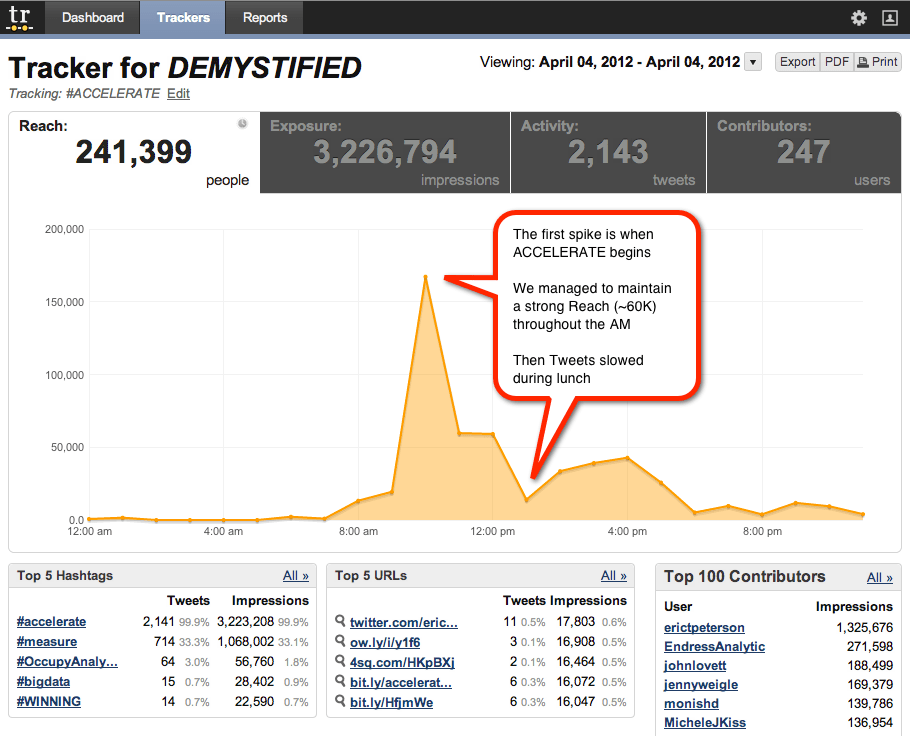
- Twitter-friendliness Part 2 — throughout the day, Eric Peterson encouraged attendees to use both #ACCELERATE and #measure as they tweeted, and there were incentives for participants to tweet (with quality tweets) both before and during the event (with winners selected using Twitalyzer and TweetReach). This had the effect of #ACCELERATE dominating the #measure world for the day (at one point, TweetReach reported that over 70% of all #measure tweets for the day also included #ACCELERATE in the tweets). That meant that no one who is at least nominally following the #measure hashtag could fail to be aware of the event and aware of the fact that it was a very “socially active” conference.
- Twitter-maybe-not-so-friendliness Qualifier — the slightly unfortunate side effect of the “10 tips” presentation format, combined with the tweet encouragement, was that it was really easy to simply tweet the title of each “tip,” which often really weren’t all that useful without listening and re-articulating the presenter’s explanation of the tip. A tweet I saw from a non-attendee asked a good question on that front:
“…most of the #measure tweets today were about #ACCELERATE… but was it always relevant?”
- Post-event buzz bounty — Eric tacked on an incentive for conference attendees to write about (either publicly or privately in an email) their experiences at the event, with the Analytics Demystified team being the judges of the “best” write-up. I suspect that will result in a higher number of blog posts than would otherwise have occurred.
Overall, it was a big win on the Twitter front — I haven’t been to a conference that so actively leveraged the platform both for pre-event buzz generation and during-event content sharing (and further buzz generation). See the last section of Michele Hinojosa’s post for more detail on the Twitter activity.
Presentations Functioning on Two Levels
When it came to the presentation structure, the organizers bent over backwards to set the speakers up for success. In his recap of the event, Corry Prohens credited Craig Burgess with the following observation:
“The conference was also a study on presentation styles and techniques. How often do you get to see 26 presentations in a day? It is a rare opportunity to spot trends and take note of what works. In a field where we all have to present what we know (to clients, stakeholders, etc.) this was a big value-add to the digital measurement insights.”
This was an excellent point. Any conference is going to include sessions that stand out as being fantastic, as well as a few sessions that fall flat. One notable exception (qualifying full disclosure: it’s a conference I’ve never attended): TED. Whether Eric and company consciously drew inspiration from TED or not, I don’t know, but there are two taglines on the TED home page that could easily be applied to the aspirations for #ACCELERATE:
“Ideas worth spreading”
“Riveting talks by remarkable people, free to the world”
By packing so many sessions into a single day and enforcing brevity (out of necessity), #ACCELERATE had a great pace and kept the attendees engaged for the entire event. Presenters were pushed to bring their “A” game to their sessions, both by repeated reminder-admonitions from Eric, as well as by the inclusion of audience-awarded $500 Best Buy gift cards for the top session of each format.
The presentations were set up to effectively convey useful and engaging content. At the same time, the presentations were set up to give the presenters a set of liberating constraints — establishing distinct guardrails for the content that then empowered the presenters to really focus in on the content and the way they communicated it. This benefited the presenters, certainly, by helping them hone the craft of presenting (that was my experience, at least), but it also benefited the audience by exposing them to a large number of presenters in a concentrated period. I hope everyone took away a few useful nuggets that they can incorporate into their own future presentations (internally or at conferences).
I haven’t attended a single conference in the last 18 months where one of the sub-themes of the conference wasn’t, “As analysts, we’ve got to get better at telling stories rather than simply presenting data.” There is real value in a conference that is designed to help analysts develop their storytelling chops.
Audience Participation
Having the audience directly vote for the winning presentation was another innovation from the event. While it is not at all unheard of to have audience-based voting on presentations, the fact that #ACCELERATE put this at the forefront was something new for digital analytics conferences, as far as I’m aware.
OpinionLab’s DialogCentral platform was leveraged to allow real-time voting and feedback on each session as it occurred. I saw a demo of DialogCentral over a year ago, found it intriguing, and then could never remember what it was called or what ever happened to it, so it was good to see it put into action. Any audience member who had a smartphone could quickly navigate to a mobile-optimized site and vote the presentation on a 5-point scale, leave an open-ended comment, and leave contact info if desired.
There were some glitches on that front, in that there were some participants who did not have smartphones (well, 2 or 3), and at least one attendee reported that the system did not work on her Blackberry. Overall, the voting occurred in smaller numbers than I think the organizers hoped, but it was a great idea and it worked perfectly adequately for a first-time attempt.
And…It Was Free
It’s easy to simply rattle off that “free is better” and leave it at that. As a first-time event, I’m sure the fact that the event was fully sponsor-supported helped make it fill up quickly. The challenge with having a free event is that the registrants have no real skin in the game — it’s easy to sign up first and then figure out if you can actually attend. If you can’t, well, no worries, because it’s no money out of your pocket! Having co-organized Web Analytics Wednesdays in Columbus — also free events — for several years now, I’ve lived with this challenge firsthand. Trying to accurately predict the no-show rate is an art unto itself, which introduces a range of logistical headaches.
At the other extreme from “free,” the major established digital analytics conferences all have hefty price tags, which makes them cost-prohibitive for many potential attendees who are operating in organizations that have extremely limited training and conference budgets (not to mention the personal budgets for analysts who are in between jobs and could really benefit from the networking opportunities at conferences). That, I suspect, leads to misaligned speaker incentives — members of the industry desperately angling for speaking slots so they can reduce the cost of the overall conference attendance rather than because they have something unique and worthwhile to share.
I could totally see #ACCELERATE evolving to have a nominal registration fee — something like $100 would ensure there was a real commitment required by registrants, but it would also make it totally feasible for someone to attend without corporate backing (make it $25 for students, and, heck, provide bartered alternatives where people can blog about the event or get referral credits).
Overall, free is good, and that made the event right-sized — ~300 people was enough to keep a single track, provide plenty of opportunity for worthwhile networking, while also keeping the setting relatively intimate.
I’m looking forward to Chicago!